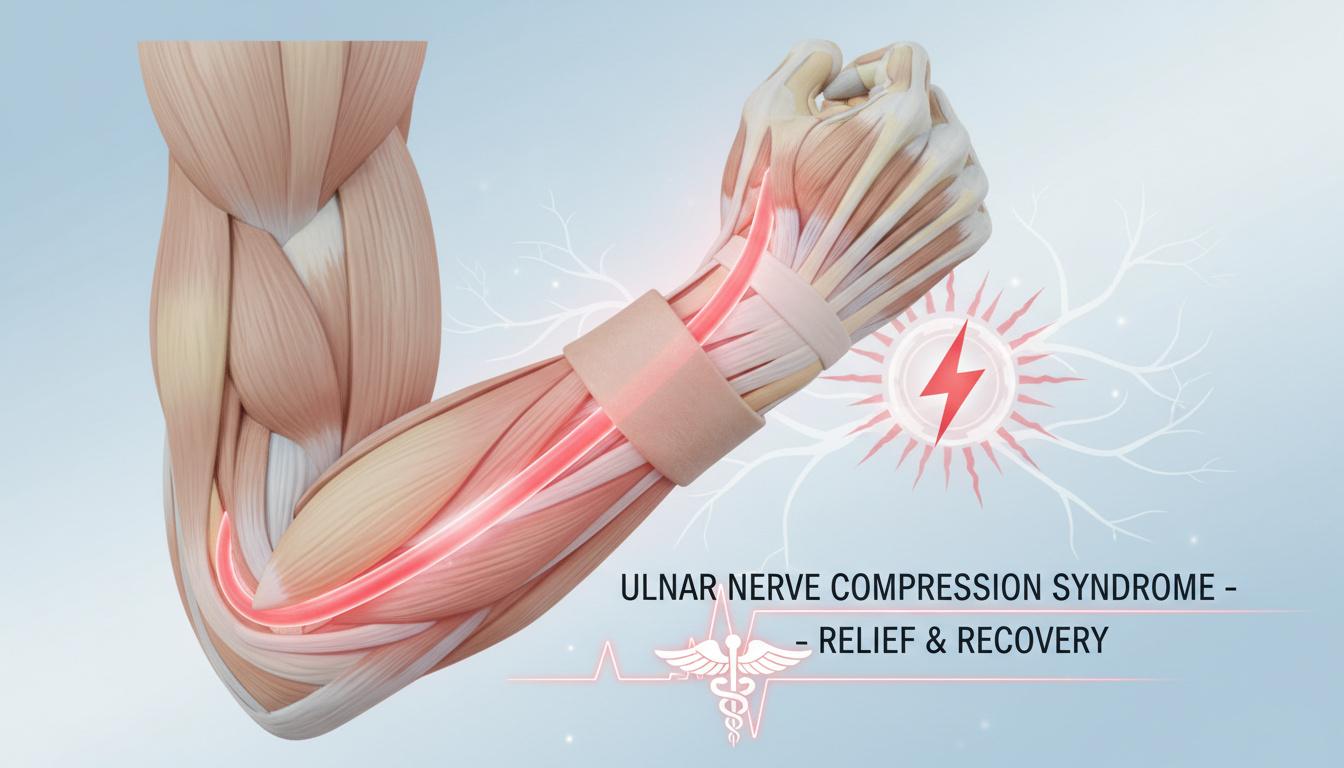
Cubital tunnel syndrome develops when the ulnar nerve becomes compressed at the elbow, specifically at the medial epicondyle—the bony point commonly called the “funny bone.” This entrapment disrupts nerve signals traveling to the hand, producing characteristic numbness and weakness in the ring and little fingers.
Clinicians classify this condition as the second most common upper extremity mononeuropathy, surpassed only by carpal tunnel syndrome in prevalence. Unlike carpal tunnel, which involves the median nerve at the wrist, cubital tunnel syndrome specifically affects the ulnar nerve as it passes through a narrow tissue tunnel at the inner elbow.
The syndrome emerges through multiple mechanisms, including sustained elbow flexion, direct pressure against hard surfaces, or structural abnormalities within the joint. Persistent compression without intervention risks permanent nerve damage and irreversible muscle atrophy in the hand.
What Is Cubital Tunnel Syndrome?
Compression neuropathy of the ulnar nerve at the cubital tunnel, located at the medial epicondyle of the elbow.
Numbness, tingling, and pain radiating from the inner elbow to the ring and pinky fingers, often worsening at night.
Prolonged elbow bending, direct pressure on the nerve, repetitive motion, or anatomical variations like bone spurs.
Non-surgical management for mild cases; surgical decompression for moderate-to-severe or progressive weakness.
- Prevalence ranking: Represents the second most common upper extremity entrapment neuropathy after carpal tunnel syndrome.
- Conservative success: Non-surgical treatments achieve approximately 85% success rates in mild cases.
- Surgical recovery: Full healing typically requires three to six months following operative intervention.
- Irreversible risks: Untreated compression may lead to permanent nerve damage and intrinsic hand muscle atrophy.
- Anatomical distinction: Affects the ulnar nerve at the elbow, unlike carpal tunnel syndrome which involves the median nerve at the wrist.
| Medical Term | Ulnar nerve entrapment at the elbow (cubital tunnel syndrome) |
|---|---|
| Affected Structure | Ulnar nerve at medial epicondyle |
| Common Name | “Funny bone” syndrome |
| Primary Digits Affected | Ring finger and little finger |
| Diagnostic Confirmation | EMG/NCS, Tinel’s sign, imaging studies |
| Non-surgical Success Rate | ~85% for mild presentations |
| Surgical Procedures | In situ decompression, anterior transposition |
| Post-operative Recovery | 3-6 months for full function |
| High-risk Groups | Office workers, athletes, individuals with prolonged elbow flexion |
Common Causes and Risk Factors
Compression typically arises from sustained pressure against the inner elbow, such as leaning on armrests during desk work or driving. UConn Health specialists note that repetitive elbow motion and prolonged flexion—particularly during sleep—stretch the ulnar nerve and exacerbate symptoms.
Anatomical abnormalities contribute significantly to nerve entrapment. Bone spurs, cysts, tumors, or thickened tissues within the cubital tunnel physically narrow the passage, while some individuals experience nerve subluxation, where the ulnar nerve snaps over the medial epicondyle during motion. Orthopaedic specialists identify athletes performing repetitive throwing motions and office workers maintaining prolonged elbow pressure as populations facing elevated risk.
What Are the Symptoms of Cubital Tunnel Syndrome?
Early Warning Signs
Initial manifestations include intermittent numbness, tingling, or “pins and needles” sensations specifically localized to the ring and pinky fingers. Cleveland Clinic physicians report these symptoms frequently intensify during elbow flexion or at night when patients sleep with bent elbows. Patients may also experience aching or burning pain along the inner elbow that radiates toward the forearm.
Advanced Symptoms
Progressive compression produces measurable weakness in the small muscles of the hand, compromising fine motor control and grip strength. Tasks requiring pinching or precise finger coordination become increasingly difficult. OHSU neurologists warn that untreated cases may result in visible muscle wasting or atrophy, particularly in the hand’s intrinsic muscles, alongside permanent nerve damage.
Symptoms often peak during sleep due to unconscious elbow flexion. Night splinting to maintain a straight elbow position frequently provides significant relief within the first few weeks of consistent use.
How Is Cubital Tunnel Syndrome Diagnosed?
Physical Tests
Physicians begin with a focused clinical history and physical examination. Tapping over the ulnar nerve at the medial epicondyle—Tinel’s sign—reproduces tingling in the ring and pinky fingers when positive. Recent clinical reviews confirm that sustained elbow flexion for three to five minutes can provoke symptoms, serving as a practical diagnostic maneuver.
Imaging and Nerve Studies
Electromyography (EMG) and nerve conduction studies (NCS) provide objective measurements of nerve function and severity while excluding alternative diagnoses. Hospital for Special Surgery guidelines recommend ultrasound, MRI, CT, or X-rays to identify structural causes such as bone spurs or cysts. Blood tests may screen for underlying metabolic conditions like diabetes or thyroid dysfunction that could mimic or exacerbate neuropathy.
| Condition | Key Distinctions |
|---|---|
| Carpal tunnel syndrome | Median nerve compression at wrist; affects thumb, index, and middle fingers rather than pinky/ring. |
| Guyon’s canal syndrome | Ulnar nerve compression at wrist; hand symptoms without elbow pain or tenderness. |
| Cervical radiculopathy | Neck pain with dermatomal pattern; worsens with neck motion rather than elbow position. |
| Thoracic outlet syndrome | Symptoms aggravated by overhead activity; possible pulse changes in affected limb. |
What Are the Treatment Options for Cubital Tunnel Syndrome?
Non-Surgical Treatments
First-line management for mild presentations emphasizes activity modification and mechanical support. Night splinting maintains the elbow in extension during sleep, preventing sustained flexion that stretches the nerve. AAOS guidelines recommend nonsteroidal anti-inflammatory drugs for pain management and padded armrests to eliminate direct pressure.
Supervised physical therapy incorporating nerve gliding exercises and forearm stretches helps mobilize the ulnar nerve and reduce adhesions. Patients typically monitor symptoms for six or more weeks before reassessing treatment efficacy. Supervised physical therapy incorporating nerve gliding exercises and forearm stretches helps mobilize the ulnar nerve and reduce adhesions, and you can learn more about West Nile virus symptoms.
Approximately 85% of mild cases resolve with consistent non-surgical management, including activity modification, splinting, and ergonomic adjustments.
Surgical Options
Surgical intervention becomes necessary for moderate-to-severe cases, progressive weakness, or when conservative measures fail after an adequate trial. Contemporary surgical reviews describe two primary approaches: in situ decompression, which releases constricting tissue while leaving the nerve in place, and anterior transposition, which relocates the nerve to a position with less tension during elbow movement.
Clinicians recommend operative evaluation when patients develop muscle atrophy, persistent numbness lasting longer than six weeks, or measurable weakness that impairs daily function.
How Long Does Recovery Take?
-
Initial Symptom Phase (Weeks): Intermittent numbness and tingling begin, often triggered by specific activities or sleep positions.
Source: Cleveland Clinic -
Progressive Phase (Months): Symptoms become more constant, potentially interfering with fine motor tasks and daily activities.
Source: Hospital for Special Surgery -
Intervention Point (6+ Weeks): Medical evaluation recommended if symptoms persist beyond six weeks or weakness develops.
Source: Cleveland Clinic -
Non-Surgical Recovery: Improvement typically occurs within weeks to months following consistent conservative treatment.
Source: American Academy of Orthopaedic Surgeons -
Post-Surgical Healing: Full functional recovery requires three to six months, with initial splinting for one to three weeks followed by rehabilitation.
Source: Oregon Health & Science University
Definitive Signs and Diagnostic Uncertainties
| Established Clinical Findings | Areas of Uncertainty |
|---|---|
|
|
Understanding Risk Factors and Context
The ulnar nerve’s superficial position at the medial epicondyle leaves it vulnerable to external pressure and stretching. Occupations requiring prolonged elbow flexion—such as holding telephones, typing with bent arms, or operating machinery—create sustained tension on the nerve. Orthopaedic specialists emphasize that both sedentary office workers and repetitive-motion athletes face comparable risks, though through different mechanical mechanisms.
Structural variations in the cubital tunnel’s anatomy, including the presence of an arcade of Struthers or muscle anomalies, may predispose certain individuals to earlier symptom onset. For those facing chronic health challenges, exploring resources like Isaiah 41:10 meaning may provide contextual emotional support during lengthy treatment protocols.
Expert Perspectives and Clinical Authority
Cubital tunnel syndrome represents a significant clinical entity requiring careful differentiation from cervical radiculopathy and other upper extremity neuropathies. Electrodiagnostic testing remains essential for accurate staging and treatment planning.
— PMC Review, 2023
Approximately 85 to 90 percent of patients experience significant relief following appropriate surgical intervention, though recovery requires patience and dedicated rehabilitation.
— American Academy of Orthopaedic Surgeons
Summary of Key Considerations
Cubital tunnel syndrome requires prompt recognition to prevent permanent ulnar nerve damage and hand dysfunction. While mild cases respond favorably to conservative measures including night splinting and activity modification, progressive symptoms or muscle weakness warrant surgical evaluation. Successful outcomes depend on accurate diagnosis distinguishing this condition from carpal tunnel syndrome and cervical pathologies, followed by appropriate staging and treatment selection. For additional perspective on finding strength during medical challenges, consider the Isaiah 41:10 context and promises.
Frequently Asked Questions
Is cubital tunnel syndrome serious?
Yes, potentially. Untreated compression can lead to permanent nerve damage and irreversible muscle atrophy in the hand. Early intervention prevents permanent weakness.
Can cubital tunnel syndrome be cured?
There is no definitive “cure” in the traditional sense; treatment focuses on nerve decompression and symptom management. Many cases resolve with conservative care, while others require surgical intervention to prevent progression.
When is surgery needed for cubital tunnel syndrome?
Surgery becomes indicated for moderate-to-severe cases, progressive muscle weakness, visible atrophy, or when non-surgical treatments fail after six or more weeks of consistent use.
How to sleep with cubital tunnel syndrome?
Maintain straight elbows using a night splint or towel wrapping. Avoid sleeping with arms flexed or tucked under pillows. Pillow support under the forearm helps maintain neutral positioning.
What exercises help cubital tunnel syndrome?
Nerve gliding exercises and gentle forearm stretches, performed under physical therapy supervision, help mobilize the ulnar nerve and reduce symptoms. Avoid aggressive stretching that increases tingling.
What is the difference between cubital and carpal tunnel syndrome?
Cubital tunnel syndrome involves ulnar nerve compression at the elbow, affecting the ring and pinky fingers. Carpal tunnel syndrome involves median nerve compression at the wrist, affecting the thumb, index, and middle fingers.

Priya Mitchell leads fact-checking, source verification and corrections at Australia Data.