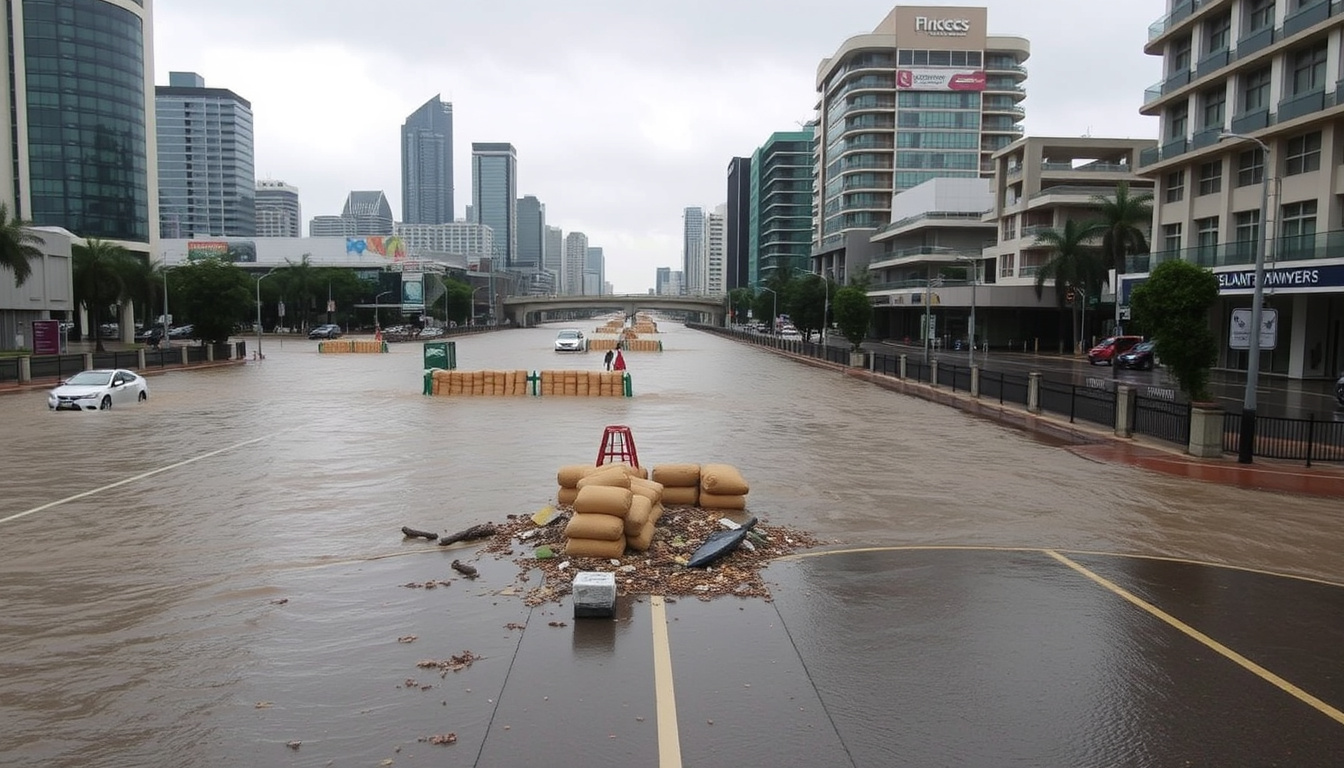
For more than five decades, Brisbane figured it was mostly safe from tropical cyclones — until March 2025 brought Severe Tropical Cyclone Alfred and the wettest 24 hours the city had seen since 1974.
An independent review released 20 May 2025 found Council delivered an effective, strong response despite the unprecedented nature of the event.
Event Date: 8 March 2025 · Major Floods in 50 Years: Fourth · Review Published: 20 May 2025 · Buyback Homes: 16 impacted residents
Quick snapshot
- First tropical cyclone to affect Brisbane since 1974 (Inside Local Government)
- Brisbane recorded 275.2 mm rainfall in 24 hours on 10 March 2025, breaking the 1974 daily record (Inside Local Government)
- Paul de Jersey’s review found Council delivered an effective, strong response and recovery effort (Inside Local Government)
- Council committed to action all 12 recommendations from the 2025 review (Inside Local Government)
- Whether future cyclone frequency in Brisbane will increase given climate projections
- Exact suburb-level flood extent mapping from the March 2025 event remains under IGEM review
- Outcomes of advocacy for Enviromon system continuation and Voluntary Home Purchase Scheme
- ARPC declared Cyclone Alfred from 25 February 2025 to 8 March 2025 6:00am AEST (Guy Carpenter)
- Queensland Government defined event period as 1–16 March 2025 (Queensland Reconstruction Authority)
- IGEM is currently reviewing Tropical Cyclone Alfred’s impact on South East Queensland (Inspector-General Emergency Management QLD)
- Council must implement all 12 recommendations from Paul de Jersey’s review
- 16 homes identified for potential council buyback under Voluntary Home Purchase Scheme
- Federal Enviromon system continuation advocacy ongoing
| Field | Value |
|---|---|
| Cyclone Name | Severe Tropical Cyclone Alfred |
| Landfall Proximity | North of Brisbane, 8 March 2025 |
| Brisbane 24hr Rainfall | 275.2 mm (10 March 2025) |
| Public Transport Suspended | After 5 March 2025 |
| QLD Government Event Period | 1–16 March 2025 |
| 2022 Flood Review Recommendations | 37 (all completed or actioned) |
| 2025 Review Recommendations | 12 |
| Review Public Release | 20 May 2025 |
| Wind Gusts | Over 100 km/h in Brisbane and Gold Coast areas |
| Last Brisbane Cyclone | 1974 |
Which Brisbane suburbs will be affected by Cyclone Alfred?
The cyclone’s trajectory spared Brisbane a direct eyewall strike, but its rainbands proved devastating. The system crossed the coast north of Brisbane on 8 March 2025, delivering the heaviest rainfall the city had seen in more than five decades. Ex-Tropical Cyclone Alfred continued to produce intense rainfall for several days, with flash flooding warnings issued for suburbs such as Carindale, which recorded 144 mm in just six hours as the storm’s remnants passed through.
Flood-prone areas identified
Brisbane’s flood history shaped where impacts hit hardest. The city learned painful lessons from the catastrophic February 2022 floods, which followed an identical track to the devastating 2011 event. Suburbs with properties in known flood zones — many still recovering — faced renewed inundation when Alfred’s rainfall overwhelmed urban drainage systems. Guy Carpenter’s post-event analysis notes that heavy rainfall caused localised inundation in flood-prone areas across the region.
Council warnings and maps
Brisbane City Council maintained its FloodWise Property Report system throughout the event, allowing residents to check their property’s flood risk. The review highlighted that Council’s approach to public communication and evacuation coordination built on improvements implemented after the 2022 Flood Review. PreventionWeb reported that as remnants of ex-Tropical Cyclone Alfred moved through in mid-March, authorities urged residents in historically flood-affected areas to remain “very high alert.”
The 2022 Brisbane Flood Review by Paul de Jersey contained 37 recommendations, all of which Brisbane City Council had completed or was actively actioning when Cyclone Alfred struck. That prior investment in resilience appears to have paid dividends during the 2025 event.
The pattern of repeatedly flooded suburbs — and the Council buyback scheme targeting 16 properties — confirms that certain areas carry structural risk that individual preparedness cannot fully mitigate.
Did Cyclone Alfred already hit Brisbane?
Yes. Cyclone Alfred made landfall as a tropical cyclone on 8 March 2025, and its impacts extended well beyond that date. The Australian Reinsurance Pool Corporation declared the cyclone period from 25 February 2025 8:30pm AEST until 6:00am AEST on 8 March 2025, though the Queensland Government defined the broader severe weather event period as 1–16 March 2025.
Crossing timeline
The system approached from the Coral Sea, with public transport suspended after the final service on 5 March 2025 as pre-storm preparations intensified. The cyclone crossed the coast north of Brisbane near Moreton Bay on the morning of 8 March 2025. However, the most severe flooding occurred after the system transitioned to an ex-tropical cyclone and stalled over South East Queensland, dumping extraordinary volumes of rain from 9–10 March 2025. This pattern — a relatively weak direct impact followed by catastrophic rainfall — proved costlier than a direct hit might have been.
Impact confirmation
Brisbane recorded 275.2 mm of rainfall on 10 March 2025, the wettest 24-hour period since records from January 1974, according to Guy Carpenter’s post-event analysis. Wind gusts exceeded 100 km/h across the Brisbane and Gold Coast areas. Beaches were stripped of sand, and coastal infrastructure was weakened by abnormally high tides. The 2025 Queensland floods, spanning late January to April 2025, caused at least 33 fatalities and more than $1.2 billion AUD in damages as of mid-April, per Wikipedia’s compilation of available data — though Brisbane’s portion of those costs remains disaggregated.
Should I tape my windows for Cyclone Alfred?
Emergency management authorities consistently advise against window taping as a cyclone protection measure. The practice became a subject of public discussion ahead of Cyclone Alfred’s approach, but experts stress that tape does not strengthen glass and can create dangerous shatter patterns if windows fail under wind pressure.
Effectiveness of taping
Taping windows is primarily a relic from wartime preparedness rather than modern cyclone science. When wind speeds reach 70 mph (approximately 113 km/h) — the threshold where structural damage typically begins — standard window glass shatters regardless of tape. More problematically, tape can cause broken glass to adhere in larger, sharper pieces rather than dispersing into smaller, safer fragments. Authorities recommend taping only as a last-resort measure when no other protection is available, and never as a primary strategy.
Better preparation methods
Impact-resistant shutters, laminated glass, or properly installed storm screens provide genuine structural protection. For residents without permanent protections, boarding windows with thick plywood — properly sealed at edges — offers meaningful protection against windborne debris, the primary danger during cyclones. The Queensland Government’s Get Ready Queensland programme provides practical preparation checklists beyond the taping question, including securing outdoor furniture, clearing gutters, and knowing your evacuation route. Council’s sandbag self-service centres, commended in the review, provide free sandbags for residents in flood-prone areas, addressing the more immediate flooding risk Brisbane faces from storms like Alfred.
Brisbane’s primary cyclone threat is flooding, not wind damage. Resources directed toward flood preparation — checking FloodWise reports, elevating valuables, knowing your evacuation centre — deliver far more protection than window tape for an event like Alfred.
Residents who prioritised sandbag placement and FloodWise monitoring over window tape emerged better prepared for the actual impacts Alfred delivered.
What suburbs are at risk of flooding in Brisbane?
Brisbane’s flood risk concentrates in suburbs along the Brisbane River and its tributaries, with a pattern that repeated across 2011 and 2022. The city’s geography creates a funnel effect where upstream rainfall channels enormous volumes of water through the urban core. Cyclone Alfred’s rainfall fell primarily in already-saturated catchments, triggering rapid river rises.
FloodWise reports
Brisbane City Council’s FloodWise Property Report system allows any resident to enter their address and receive a property-specific flood risk assessment. The service was maintained throughout the Cyclone Alfred event and provides historical flood level data, catchment information, and recommended preparation actions. Areas consistently flagged include suburbs along the Brisbane River corridor and low-lying areas in the city’s western suburbs.
Cyclone-specific risks
While riverine flooding follows predictable patterns tied to river levels, Cyclone Alfred introduced a flash flooding component that caught some residents unprepared. Carindale recorded 144 mm in six hours as the system’s remnants moved through, generating rapid overland flows typical river flood modelling. This type of rainfall-driven flash flooding affects areas not traditionally inundation zones, particularly where urban drainage is overwhelmed by sudden, intense precipitation. Council identified 16 homes for potential buyback under a proposed Commonwealth/State funded Voluntary Home Purchase Scheme — a scheme recommended in the review to address properties repeatedly flooded but where owners prefer relocation over rebuilding.
Which area will be worst affected by Cyclone Alfred?
South East Queensland bore the brunt of Cyclone Alfred’s impacts, with Brisbane at the centre of the storm’s most destructive rainfall. The region had not experienced a tropical cyclone since 1974, making the March 2025 event both meteorologically significant and operationally challenging for emergency managers.
Predicted worst-hit zones
Before landfall, modelling suggested areas north of Brisbane’s crossing point would face the most severe wind impacts, but the actual worst effects came from rainfall rather than wind. Suburbs along creeks and low-lying areas experienced the most severe flooding, with some areas seeing water levels approaching 2022 highs. The Review noted that Council’s public transport response, sandbag distribution, and waste management were commended in the review — operational areas that prevented secondary impacts from compounding the primary flooding.
Post-event assessments
Paul de Jersey’s independent review, published 20 May 2025, found that Brisbane City Council delivered an effective, strong response and recovery effort. “Council had performed very well and the people of Brisbane rose outstandingly to the challenge,” de Jersey stated in his assessment. Lord Mayor Adrian Schrinner emphasised that the review validated Council’s approach: “Review found Council delivered an effective, strong response and recovery effort.” The review made 12 recommendations, including improving disaster recovery funding gaps, advocating for the Federal Enviromon system’s continuation, and refining evacuation centre operations.
Council’s effective response during Cyclone Alfred does not eliminate the need for continued investment. The review recommends a Commonwealth/State funded Voluntary Home Purchase Scheme for repeatedly flooded properties — a policy decision that requires state and federal coordination. Whether that political alignment materialises before the next significant event remains uncertain.
The 16-home buyback scheme signals that even an effective Council response cannot fully protect residents in the highest-risk locations, and that structural relocation — not just emergency management — must be part of the resilience conversation.
Timeline
Five milestones trace the arc from Cyclone Alfred’s approach to the independent review’s publication.
- : ARPC declares Cyclone Alfred (period runs through 8 March 2025)
- : Public transport suspended after final service in preparation for the cyclone
- : Cyclone Alfred crosses coast north of Brisbane
- : Peak rainfall — 275.2 mm recorded in 24 hours
- : Paul de Jersey review of Council’s response publicly released
Confirmed facts versus what remains unclear
The review establishes a clear factual record on some aspects of Cyclone Alfred and the Council response, while leaving other questions open.
Confirmed facts
- Cyclone Alfred crossed north of Brisbane on 8 March 2025
- Brisbane recorded 275.2 mm rainfall on 10 May 2025, the wettest day since 1974
- Brisbane’s first tropical cyclone since 1974
- Paul de Jersey review released 20 May 2025 with 12 recommendations
- Council committed to action all 12 recommendations
- 16 homes identified for potential Voluntary Home Purchase Scheme buyback
- All 37 recommendations from the 2022 Flood Review were completed or actioned before Alfred
What’s unclear
- Exact suburb-level flood extent for the March 2025 event remains under IGEM review
- Whether cyclone frequency affecting Brisbane will increase given climate projections
- Whether advocacy for Enviromon system continuation will succeed
- Outcomes of the Voluntary Home Purchase Scheme proposal pending federal and state approval
- Comparison of Brisbane’s response effectiveness versus other South East Queensland councils
Quotes
Brisbane City Council delivered an effective, strong response and recovery effort to Tropical Cyclone Alfred.
— Paul de Jersey, Former Governor and Supreme Court Chief Justice, Independent Reviewer (Inside Local Government)
Council had performed very well and the people of Brisbane rose outstandingly to the challenge.
— Paul de Jersey, Former Governor and Supreme Court Chief Justice (Inside Local Government)
Review found Council delivered an effective, strong response and recovery effort.
— Adrian Schrinner, Brisbane Lord Mayor (Newsreel)
The review assessed the 2022 Brisbane Flood Review recommendations and Council’s response to the March 2025 tropical cyclone event, determining that all 37 prior recommendations had been “conscientiously attended to.” Council’s approach to public transport coordination, sandbag distribution, and waste management was specifically commended. Recommendations in the 2025 review included refining evacuation centres, advocating for the Federal Enviromon weather system to remain operational, and addressing disaster recovery funding gaps through a proposed Commonwealth/State funded Voluntary Home Purchase Scheme for repeatedly flooded properties.
What comes next for Brisbane’s resilience programme
Paul de Jersey’s review frames Cyclone Alfred as a test Brisbane passed, not a crisis that exposed systemic failure. But passing one test does not guarantee readiness for the next. The review’s 12 recommendations chart a course toward greater resilience — from improving evacuation centre readiness to securing permanent funding for voluntary property buybacks. The Queensland Reconstruction Authority continues recovery operations across the state, while the Inspector-General Emergency Management reviews the broader 2025 weather events including Cyclone Alfred’s impacts on North Queensland, South East Queensland, and Western Queensland.
For Brisbane residents, the practical implications are clear: flood risk persists, window tape is ineffective, and the city’s emergency dashboard and FloodWise systems represent tools worth knowing before the next warning arrives. Council has committed to acting on all 12 recommendations, but the most consequential items — particularly the Voluntary Home Purchase Scheme — require state and federal buy-in that has not yet materialised. The question for Queensland’s disaster planners is whether the political will to fund lasting solutions will arrive before another 50-year event does.
Related reading: Collingwood vs Brisbane 2025 Prelim Final
en.wikipedia.org, brisbane.qld.gov.au, preventionweb.net, igem.qld.gov.au, tmr.qld.gov.au
Council flood defenses held firm, yet airport closure updates persisted amid Cyclone Alfred’s deluge, complicating regional recovery efforts.
Frequently asked questions
Why don’t cyclones hit Brisbane?
Brisbane is located at the southern edge of the typical tropical cyclone track along Australia’s east coast. Most cyclones curve eastward before reaching Brisbane latitude, or weaken over cooler waters. Cyclone Alfred was notable precisely because it maintained sufficient strength to make landfall north of the city — the first tropical cyclone to affect Brisbane since 1974.
How to stop windows from breaking during a cyclone?
Window taping is not recommended by emergency management authorities. Impact-resistant shutters or storm screens provide genuine protection. Thick plywood properly sealed at edges is a practical alternative for temporary protection. The greater risk during Cyclone Alfred was flooding, not wind damage to windows.
Will 70 mph winds break windows?
Wind gusts above approximately 100 km/h (62 mph) can apply enough pressure to break standard window glass, particularly when accompanied by windborne debris. Cyclone Alfred produced gusts exceeding 100 km/h in the Brisbane area. Protection measures should be rated for these speeds, not the lower thresholds that window tape is sometimes promoted against.
What date did Cyclone Alfred hit Brisbane?
Cyclone Alfred crossed the coast north of Brisbane on 8 March 2025. However, the most severe flooding occurred on 9–10 March 2025 as the system transitioned to an ex-tropical cyclone and stalled over South East Queensland, producing 275.2 mm of rainfall in 24 hours.
How to flood check a property in Brisbane?
Brisbane City Council’s FloodWise Property Report system allows residents to enter their address and receive a property-specific flood risk assessment including historical flood data, catchment information, and preparation recommendations. This free service is available through Council’s official website.
What is the Brisbane flood map?
Brisbane’s flood mapping combines historical data, hydrological modelling, and river gauge records to show predicted flood levels across different rainfall scenarios. The FloodWise system provides property-specific reports rather than a single map, but the underlying data informs Council’s development regulations, emergency planning, and Buyback Scheme prioritisation.

Priya Mitchell leads fact-checking, source verification and corrections at Australia Data.