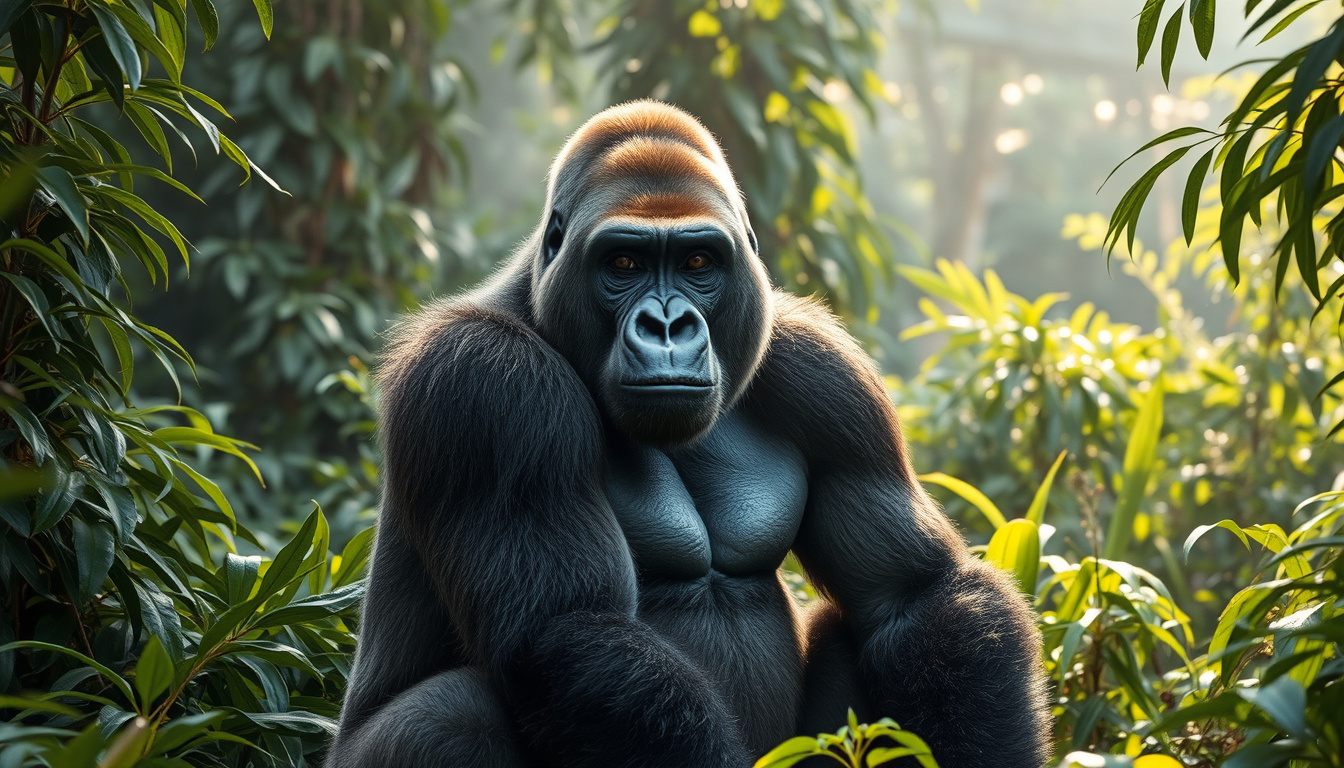
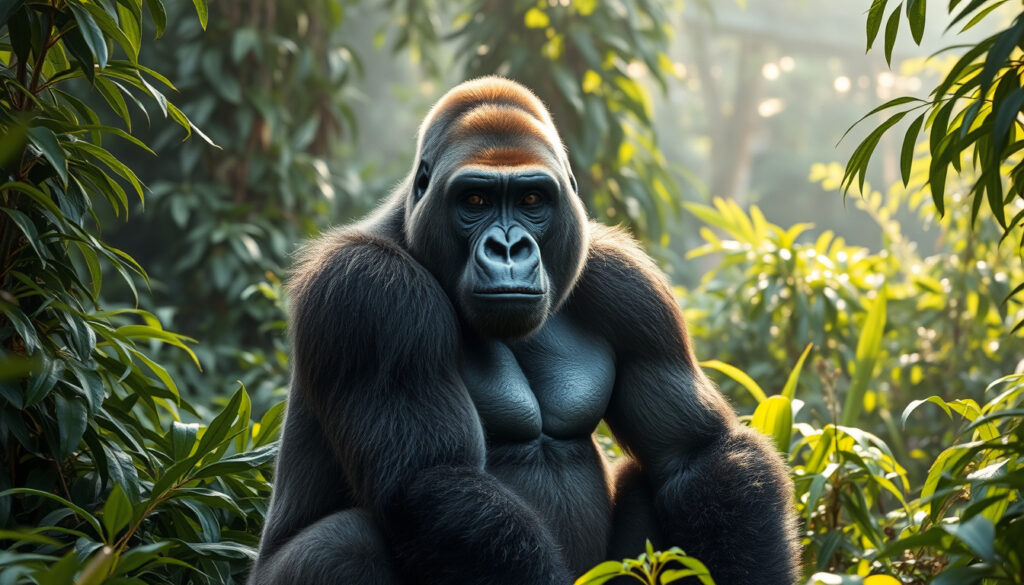
Few animals capture the imagination quite like the silverback gorilla. Standing six feet tall and weighing as much as two adult humans, the silverback is the undisputed king of the primate world, but behind the extraordinary strength lies a surprisingly gentle and complex creature.
Adult male weight: 400 lbs (181 kg) ·
Standing height: 5.5–6 ft (1.7–1.8 m) ·
Arm span: Up to 8.5 ft (2.6 m) ·
Bite force: 1,300 psi ·
Lifespan in wild: 35–40 years
Quick snapshot
- Males weigh up to 400 lbs (Gorilla Trackers (wildlife safari guide))
- Height 5.5–6 ft (World Wildlife Fund (global conservation authority))
- Arm span up to 8.5 ft (Gorilla Trackers) (Gorilla Trackers (wildlife safari guide))
- Bite force 1,300 psi (National Geographic (science and exploration authority))
- Lift up to 800 kg reportedly (Johan Siggesson (strength analysis blog))
- According to some analyses, stronger than a grizzly in upper body (YouTube analysis (comparative strength research))
- Shy and gentle unless threatened (Gorilla Trackers)
- Aggression only defensive (Johan Siggesson)
- Complex social structure with one dominant male (Gorilla Trackers)
- Central African forests (World Wildlife Fund) (IUCN Red List (global conservation authority))
- Extinction threat from deforestation (IUCN Red List (global conservation authority))
- Protected in national parks (Virunga National Park (conservation organisation))
Here is a summary of key facts about the silverback gorilla:
| Attribute | Value |
|---|---|
| Scientific name | Gorilla beringei beringei (mountain) or Gorilla gorilla gorilla (western lowland) |
| Diet | Herbivore: leaves, stems, fruit, bark (Johan Siggesson) |
| Social structure | One dominant silverback leads 5–30 members (Gorilla Trackers) |
| Conservation status | Endangered (IUCN) (IUCN Red List) |
| Lifespan in wild | 35–40 years (Gorilla Trackers) |
| Adult male weight | 400 lbs (181 kg) |
| Standing height | 5.5–6 ft (1.7–1.8 m) |
| Bite force | 1,300 psi (National Geographic) |
Can 100 Men Defeat a Silverback Gorilla?
Scientific analysis of human vs gorilla combat
- The gorilla’s bite force of 1,300 psi (National Geographic) exceeds that of most predators.
- Reportedly, a silverback can lift about 800 kg of dead weight (Johan Siggesson).
- According to some analyses, human punches have negligible effect due to gorilla muscle density (YouTube analysis).
Factors: group coordination, gorilla strength, fatal injuries
- Studies suggest apes are about 1.5 times stronger than humans pound-for-pound (YouTube analysis).
- A single swipe can break bones, and the gorilla’s speed (up to 25 mph) makes escape difficult.
- Most analysts conclude that 100 unarmed men would likely not win without weapons, but exact outcomes are unclear.
The 100-men scenario is purely hypothetical — no scientific body has tested it. The real takeaway: a silverback is so formidable that even a large group of unarmed humans would struggle to subdue it without casualties.
The implication: While strength numbers are impressive, actual combat outcome depends on psychology, terrain, and coordination — factors that make the 100-men question unanswerable with certainty.
Is a Silverback Gorilla Stronger Than a Grizzly Bear?
Five key metrics, one clear pattern: the gorilla wins in upper-body power and bite force, but the grizzly dominates in overall size and endurance.
Strength metrics: bite force, lifting capacity, stamina
| Metric | Silverback Gorilla | Grizzly Bear | Source |
|---|---|---|---|
| Bite force | 1,300 psi | 1,200 psi | National Geographic (gorilla); Wikipedia (grizzly) |
| Weight | 400 lbs (181 kg) | 600–800 lbs (270–360 kg) | World Wildlife Fund (gorilla); NPS (grizzly) |
| Height | 5.5–6 ft | 6.5–8 ft (on hind legs) | Gorilla Trackers; Wikipedia |
| Upper body strength | Approx. 1.5× human pound-for-pound (according to some analyses) | Not measured, but larger mass | YouTube analysis |
| Endurance | Short bursts | Can run for miles | NPS |
Behavioral differences: aggression, territory, fighting style
The hypothetical fight distracts from reality: grizzlies are apex predators with claws and hunting instincts, while gorillas are defensive herbivores. In a natural encounter, the bear’s size and aggression would likely prevail, but such meetings almost never occur.
The trade-off: Gorillas have superior grip and bite per pound, but grizzlies have mass and claws. No animal would willingly fight the other — their habitats and behaviors keep them worlds apart.
Is a Silverback Gorilla Aggressive?
When do silverbacks become aggressive?
- Aggression is typically defensive, triggered by threats to troop, food, or young (Gorilla Trackers).
- Actual attacks on humans are rare but can occur if the gorilla feels cornered.
Body language: chest beating, hooting, charging
- Chest beating is a warning display, often followed by a bluff charge (Johan Siggesson).
- Hooting and ground slapping escalate the threat without physical contact.
- Yawning is a sign of stress, not tiredness.
What this means: The silverback’s fearsome reputation is earned, but attacks are almost always a last resort after repeated warnings.
What Angers a Gorilla?
Direct eye contact
- Intense staring is interpreted as a challenge in gorilla social code.
Sudden movements or loud noises
- Hikers and safari tourists are advised to stay calm and avoid startling the animal (Virunga National Park).
Intrusion into personal space
- Silverback will charge if cornered, but most charges stop short of contact.
The silverback’s aggression is a last resort. For tourists in Uganda or Rwanda, the real risk is underestimating the animal’s speed — a bluff charge at 25 mph can still cause panic and accidents.
The pattern: Gorillas have clear, non-verbal communication systems. Understanding them can prevent conflict better than any physical barrier.
What Is a Gorilla’s Biggest Enemy?
Natural predators: leopards, crocodiles
- Leopards occasionally prey on young gorillas (World Wildlife Fund).
- Crocodiles in river crossings can also pose a threat.
Human threat: poaching, habitat loss
- Humans are the primary threat via deforestation and poaching (IUCN Red List).
- Habitat destruction has reduced mountain gorilla populations to fewer than 1,000 individuals.
“The forest is everything. Without it, the gorilla has no future.”
— Dian Fossey, primatologist (as recalled by conservation literature)
We treat each gorilla as an individual, monitoring health and behaviour to keep the troop stable.
— Gorilla Doctors, veterinary team (Gorilla Doctors (field veterinary programme))
Protecting gorillas means protecting entire ecosystems that benefit people and wildlife alike.
— World Wildlife Fund, conservation body (WWF)
For conservationists in Central Africa, the choice is clear: protect the forests, or lose the silverback forever.
A viral thought experiment pitting one silverback gorilla against 100 unarmed men, explored in a hypothetical strength comparison, sheds light on how human coordination measures up against raw primate power.
Frequently asked questions
How fast can a silverback gorilla run?
A silverback can reportedly run at speeds up to 25 mph (40 km/h) for short bursts, much faster than a human.
Do silverback gorillas eat meat?
Primarily herbivorous, but they have been observed eating small insects or grubs occasionally. Meat is not a dietary staple (Johan Siggesson).
How do silverback gorillas communicate?
They use a complex system of vocalizations (hoots, grunts, roars), body language (chest beats, stares), and facial expressions. Dominance is reinforced through displays.
Can a silverback gorilla be tamed?
No. Wild gorillas are not domesticated and maintain strong instincts. Even hand-raised individuals can become dangerous as adults. Conservation focuses on maintaining wild populations.
What does the silver patch on a gorilla’s back mean?
The silver patch signals sexual maturity and leadership status. Only dominant adult males develop this silver hair, which gives them the name “silverback.”
Related reading

Jack Hayes is Senior Reporter at Australia Data, covering breaking stories and explainers.