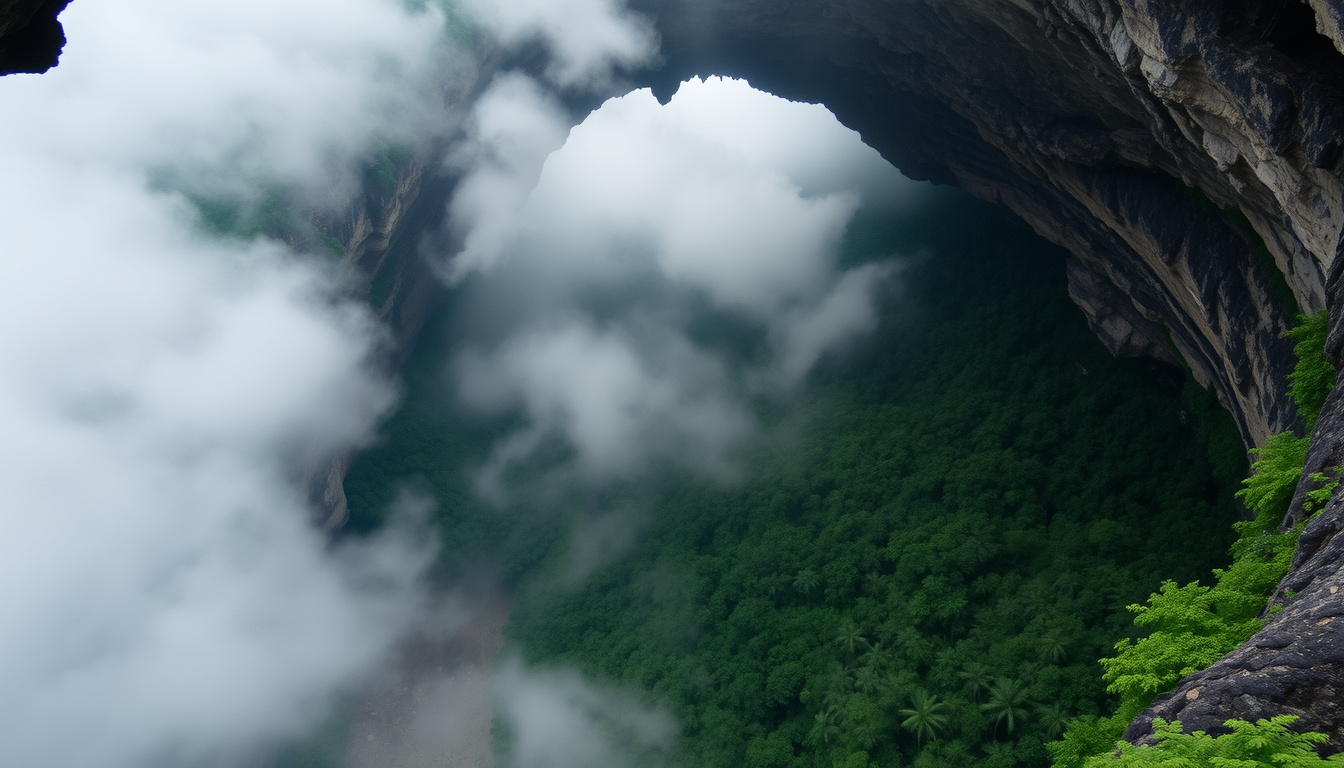
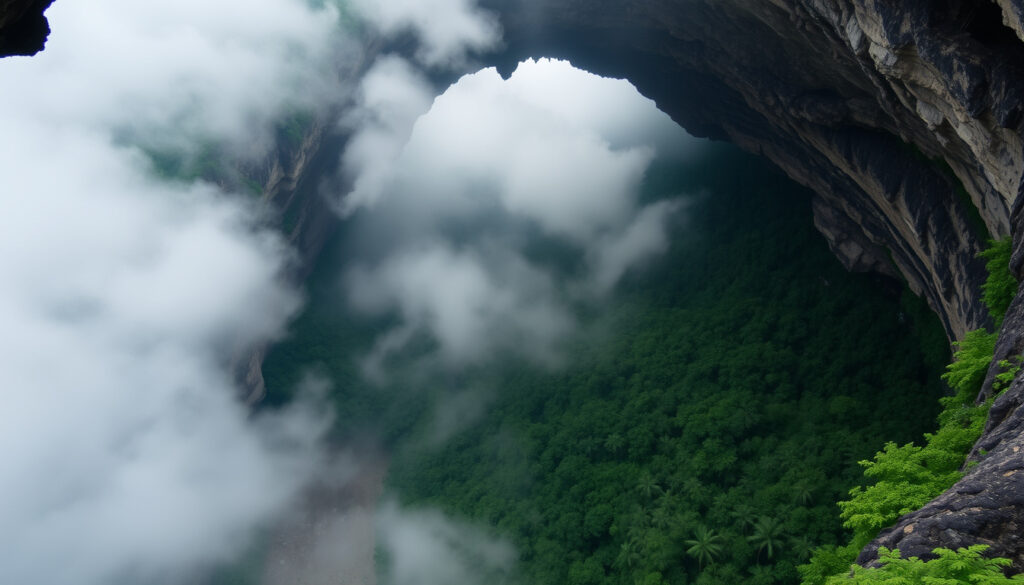
There’s something about the idea of a cave so vast it has its own weather system that makes you want to see it for yourself. Son Doong Cave in Vietnam is that place — a subterranean world where rivers flow, jungles grow, and the chambers could swallow a skyscraper.
Location: Phong Nha-Ke Bang National Park, Vietnam ·
Length: 9 kilometers (5.6 miles) ·
Volume: 38.5 million cubic meters ·
Highest Chamber: Over 200 meters (656 feet) ·
Discovery: 1990 by Ho Khanh ·
Tour Cost (per person): ~$3,000
Quick snapshot
- World’s largest cave by volume at 38.5 million m³ (Wikipedia (open encyclopedia))
- Contains a permanent subterranean river (Absolute Asia Travel (tour operator partner))
- Discovered by Ho Khanh in 1990 (Fairyburger (adventure travel blog))
- Exact total depth of some side passages (Son Doong Cave Info (enthusiast site))
- Whether undiscovered chambers exist beyond current explored sections (Son Doong Cave Info (enthusiast site))
- Long-term impact of tourism on cave ecology (Son Doong Cave Info (enthusiast site))
- 1990: Discovered by Ho Khanh (BBC Travel (news outlet))
- 2009: British caving team explores and maps the cave (BBC Travel (news outlet))
- 2013: First organized tourist expedition by Oxalis Adventure (BBC Travel (news outlet))
- Sold out tours until at least 2027 (Fairyburger (adventure travel blog))
- Oxalis may increase capacity but limited by conservation (Fairyburger (adventure travel blog))
- Growing interest from international travelers (Fairyburger (adventure travel blog))
Only about 1,000 people per year get to set foot inside Son Doong, making it one of the most rationed travel experiences on Earth. The trade-off between exclusivity and accessibility means exclusivity wins — and that scarcity is what keeps the cave intact.
The table below summarizes the key facts about Son Doong Cave.
| Attribute | Value |
|---|---|
| Location | Phong Nha-Ke Bang National Park, Vietnam |
| Length | 9 km (5.6 mi) |
| Volume | 38.5 million m³ |
| Largest Chamber | Over 200 m tall |
| River | Subterranean, fast-flowing |
| Discovery Year | 1990 |
| First Tourist Tour | 2013 |
| Annual Tourist Cap | 1,000 (approx.) |
| Tour Duration | 6 days |
| Tour Operator | Oxalis Adventure |
What is special about Son Doong cave?
Three things set Son Doong apart from every other cave on the planet: its sheer size, its self-contained ecosystem, and the story of how it remained hidden for so long.
- World’s largest cave by volume — With a volume of 38.5 million cubic meters, Son Doong is big enough to house a 40-story skyscraper or a New York City block. The largest chamber, named Hang En, stretches over 200 meters high and 150 meters wide (Wikipedia (open encyclopedia)).
- Unique ecosystem with jungle and river — A fast-flowing subterranean river runs through the cave, carving out massive passages. Sections have collapsed ceilings, allowing sunlight in and creating a jungle full of trees, ferns, and even animals — a literal cave rainforest (Absolute Asia Travel (tour operator partner)).
- Discovery myth meets reality — Ho Khanh, a local farmer, first stumbled upon the entrance in 1990 while searching for timber. The story goes that he couldn’t find it again for nearly two decades. In 2009, a British caving team, guided by Khanh, finally located the entrance and mapped the cave (BBC Travel (news outlet)).
Son Doong isn’t just a big hole in the ground — it’s a unique geological and biological system that challenges what we think a cave can be. For the Vietnamese government and Oxalis, preserving that system means limiting access, and that scarcity turns the cave into a high-stakes, high-price experience.
Why is Son Doong cave so expensive?
The $3,000 price tag is the first thing people ask about. It’s also the most misunderstood. Here are the three main drivers of that cost.
- Limited permits: only about 1,000 tourists per year — The Vietnamese authorities, in partnership with Oxalis Adventure, cap the number of visitors to protect the fragile cave ecosystem. With demand far outstripping supply, the price naturally rises (Fairyburger (adventure travel blog)).
- Multi-day expedition including camping and guides — The tour lasts 6 days and 5 nights. That includes all meals, camping gear, porters, safety equipment, and a team of professional guides and cave experts. You’re not just paying for a ticket — you’re paying for a fully supported backcountry expedition (Absolute Asia Travel (tour operator partner)).
- Remote location requiring logistics — The cave lies deep in Phong Nha-Ke Bang National Park, about 45 kilometers from Dong Hoi. Getting there involves a 4WD ride, a jungle trek, and overnight stays at base camps. All supplies must be carried in (Son Doong Cave Info (enthusiast site)).
The implication: the $3,000 isn’t a markup — it’s the cost of a small, high‑quality expedition. For comparably remote adventures in places like Patagonia or the Amazon, similar price points are standard. But Son Doong’s artificial cap on visitors makes it even more expensive relative to other mega‑caves.
How much does Son Doong cave cost?
Let’s break down the numbers. The standard published price from Oxalis Adventure (official tour operator) is US$3,000 per person. Some sources quote it as 72,000,000–79,500,000 Vietnamese đồng (Fairyburger (adventure travel blog)).
Here is a breakdown of what the tour price covers.
| Item | Included | Notes |
|---|---|---|
| Base tour price | $3,000 | 6-day expedition |
| Transport from Dong Hoi | Yes | Pick-up and drop-off |
| Camping equipment | Yes | Tents, sleeping bags, mats |
| All meals | Yes | Prepared by porters |
| Safety gear | Yes | Helmets, headlamps, harnesses |
| Oxygen monitoring | Yes | Constant checks |
| English-speaking guide | Yes | Professional caving guides |
| Flights to Vietnam | No | Must arrange separately |
The catch: tours are sold out through at least 2027. The waiting list is long, and the price doesn’t include international airfare. For a two-week Vietnam trip, total costs (including the cave tour) can easily reach $5,000–$7,000.
Are there tigers in Son Doong cave?
No. This question comes up often because of a popular myth — sometimes fueled by travel vlog clickbait — suggesting tigers live in the cave’s dark passages. But every reliable source confirms there are no tigers in Son Doong (Absolute Asia Travel (tour operator partner)).
- What’s actually there: The cave is home to blind fish, bats, insects, and other small creatures adapted to permanent darkness. The subterranean river supports a unique aquatic ecosystem.
- No large predators: Tigers need large territories and prey — Son Doong’s environment simply can’t support them. The jungle sections are small and isolated.
- Where the myth came from: Possibly a mishearing of stories about jungle wildlife in the national park above the cave, or a joke that snowballed into a “fact.”
Can tourists go to Son Doong cave?
Yes — but with strict limitations. Here’s what you need to know to plan a visit.
- Only through Oxalis Adventure — The Vietnamese government granted Oxalis exclusive rights to operate tours. You cannot book through any other company (Absolute Asia Travel (tour operator partner)).
- Physical fitness requirements — The tour is rated difficulty level 6 out of 10 (“hard”). It includes about 800 meters of steep climbing, roughly 8 kilometers of caving, and a final 90‑meter ascent known as the Wall of Vietnam (Fairyburger (adventure travel blog)).
- Oxygen levels are safe but monitored — Guides carry oxygen meters and constantly check air quality. The cave has natural ventilation through collapsed ceilings, so oxygen depletion is not a risk.
- Minimum age is 18 — And you’ll need to sign a waiver recognizing the physical and environmental demands.
The trade-off: you can visit, but you’ll need to book years ahead, be in good shape, and pay a premium. For those who make it, the experience is unmatched.
Confirmed facts
- Son Doong is the world’s largest cave by volume (Wikipedia (open encyclopedia))
- Contains a permanent subterranean river (Absolute Asia Travel (tour operator partner))
- Discovered by Ho Khanh in 1990 (BBC Travel (news outlet))
- Tour cost is $3,000 per person (Oxalis official price)
- Only about 1,000 visitors per year allowed
Rumors & unclear
- Tigers living inside Son Doong — debunked
- Exact total depth of all side passages — unknown
- Whether undiscovered chambers exist — possible but unconfirmed
- Long-term tourism impact on cave ecology — not yet studied in depth
“I found the cave by chance while looking for timber. I was afraid it might be a tiger’s den, so I didn’t go in alone. Later, I led the British team back.”
— Ho Khanh, discoverer of Son Doong Cave
“Every dollar of the tour price goes back into conservation and local communities. We limit to 1,000 visitors because the cave is alive — it breathes, it grows, and it needs protection.”
— Oxalis Adventure spokesperson
For Vietnamese adventure tourism, the lesson is clear: Son Doong is a national treasure that earns its prestige through scarcity. For travelers, the choice is either to commit to the waitlist and the price tag, or to explore other world-class caves in Phong Nha — Hang En, for example, offers a fraction of the cost and still delivers jaw‑dropping scale.
Travelers seeking practical details can consult the Hang Son Doong cave guide for up-to-date tour costs and safety tips.
Frequently asked questions
What is the best time of year to visit Son Doong cave?
The dry season from February to August offers the most reliable weather. The rainy season (September–January) can make the jungle trek treacherous and may cause river levels to rise inside the cave.
How long is the Son Doong cave tour?
The expedition lasts 6 days and 5 nights, including travel to and from Dong Hoi, jungle trekking, and three nights camping inside the cave system.
What should I pack for the Son Doong cave expedition?
Oxalis provides a detailed packing list. Essentials include sturdy hiking boots, quick-dry clothing, a headlamp, swimwear (for river crossings), and insect repellent. All camping and safety gear is supplied.
Is there an age or fitness requirement for the tour?
You must be at least 18 years old and in good physical condition. The trek involves steep climbs, long walks over uneven terrain, and sections that require swimming. A medical check is recommended.
Can I take photographs inside Son Doong cave?
Yes, photography is allowed and encouraged. Many travelers bring DSLR cameras with wide-angle lenses. Tripods are allowed but must be discussed with your guide in advance.
How do I get to Phong Nha from Hanoi or Ho Chi Minh City?
Most travelers fly to Dong Hoi (a 1-hour flight from Hanoi or 1.5 hours from Ho Chi Minh City). From Dong Hoi, Oxalis provides transfer to the national park. Trains and buses are also available but take much longer.
Is Son Doong cave open to independent travelers?
No. All tours must be booked through Oxalis Adventure. Independent access is prohibited for safety and conservation reasons.
Related stories



Liam O'Brien covers Australian politics and public affairs for Australia Data.