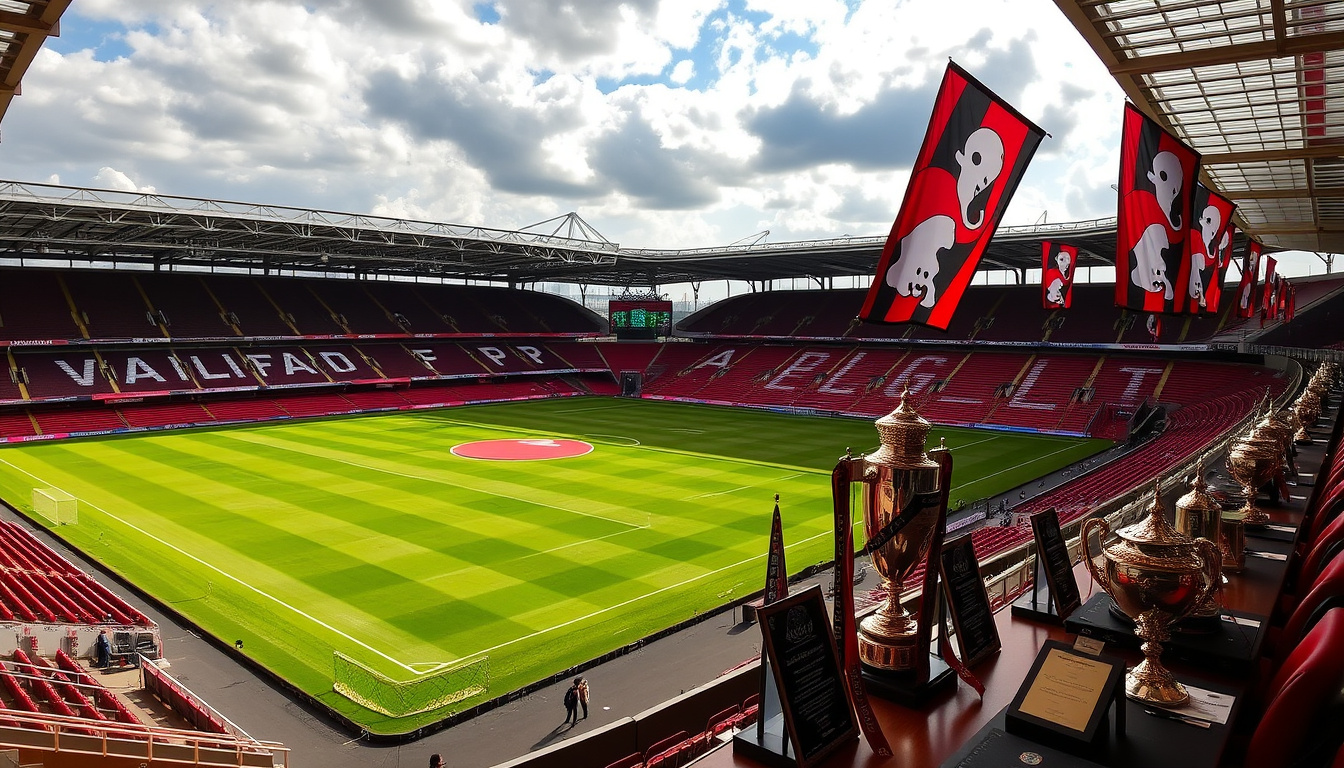
AFC Bournemouth, known affectionately as The Cherries, stands as one of English football’s most remarkable ascent stories. Founded in 1899 and based in Kings Park, Boscombe, this club from the coastal town of Bournemouth has transformed from humble amateur beginnings to a regular Premier League competitor. The journey encompasses multiple league promotions, memorable cup upsets, and a transformation under key leadership figures that reshaped its entire trajectory.
Competing in England’s top flight represents the culmination of decades of progression through the football league system. The club has earned recognition not only for its on-field achievements but also for its distinctive red and black kit, which has become synonymous with the Vitality Stadium atmosphere. Understanding AFC Bournemouth requires examining its organizational structure, historical milestones, and the facilities that have supported its growth.
The club’s identity extends beyond match results, encompassing community ties, ownership philosophy, and strategic decisions that have defined its modern era. From early FA Cup appearances in the 1910s to the landmark Premier League promotion in 2015, each chapter reflects the ambitions and challenges faced by a club determined to establish itself among England’s football elite.
What is A.F.C. Bournemouth?
Key Facts and Quick Insights
- First entered the Football League in 1923 as Bournemouth & Boscombe Athletic, initially competing in the Third Division South
- Achieved their first league title by winning the Third Division in 1987 under Harry Redknapp
- The famous 1984 FA Cup upset over Manchester United remains one of the club’s most celebrated achievements
- Three promotions in six years under Eddie Howe (2009-2015) led to the club’s first-ever Premier League entry
- Survived five consecutive Premier League seasons from 2015 onwards, marking their longest top-flight tenure
- The Vitality Stadium, also known as Dean Court, has served as the home ground since 1910
- No Premier League or FA Cup titles, but the club has accumulated multiple third-tier honors and cup victories
Club Profile Snapshot
| Category | Detail | Notes |
|---|---|---|
| Current League | Premier League | Top tier English football |
| Founded | 1899 | Originally as Boscombe St. John’s Institute FC |
| Location | Kings Park, Boscombe, Bournemouth | Dorset, England |
| Stadium | Vitality Stadium | Also known as Dean Court |
| Nickname | The Cherries | From red and black kit colors |
| Major Honours | Third Division (1987), Associate Members’ Cup (1984) | Third-tier and cup titles |
| Notable Upset | FA Cup win vs Manchester United (1984) | Historic cup victory |
| Record Achievement | First Premier League promotion (2015) | Under Eddie Howe leadership |
Who Owns and Manages A.F.C. Bournemouth?
Ownership of AFC Bournemouth resides with Max Demin, who acquired controlling interest in the club in 2011. His investment arrived at a critical juncture in the club’s history, providing financial stability during a period when the club was navigating the challenges of lower-league football. Demin’s commitment enabled the strategic decisions that would ultimately support the remarkable ascent achieved in subsequent years. More about Premier League club ownership structures demonstrates how investor involvement shapes club trajectories.
Current Leadership Structure
The managerial position at AFC Bournemouth is held by Andoni Iraola, whose appointment represents the club’s approach to appointing experienced coaches capable of operating at the Premier League level. His tenure reflects the club’s ambition to establish itself as a sustainable top-flight competitor. The leadership structure combines owner stability with managerial expertise to guide competitive performance.
Max Demin has maintained ownership since 2011, overseeing three promotions and five consecutive Premier League seasons. The current managerial arrangement positions the club for continued top-flight competitiveness while developing a squad capable of sustaining Premier League status.
Management Philosophy and Strategy
The partnership between ownership and management has emphasized youth development, strategic recruitment, and tactical flexibility. This approach has enabled the club to compete effectively despite operating with relatively modest resources compared to established Premier League clubs. The model prioritizes sustainable growth over short-term expenditure. According to football analysis from The Guardian, such models increasingly influence how smaller clubs approach top-flight competition.
History and Key Achievements of A.F.C. Bournemouth
The origins of AFC Bournemouth trace to Boscombe St. John’s Lads’ Institute FC, which operated between 1890 and 1899 before evolving into the club known today. Early years saw participation in local leagues including the Bournemouth and District Junior League from 1899 to 1900, progressing to senior amateur football by 1905-06. The first FA Cup appearance came in the 1913-14 season, establishing the club’s commitment to competitive football beyond regional boundaries.
League History and Promotions
Election to the Football League in 1923 as Bournemouth & Boscombe Athletic marked a significant milestone, with the club spending 35 years in the Third Division South. The 1946 Third Division South Cup victory demonstrated early cup competence, though sustained top-flight ambitions remained unrealized during this period. The club endured multiple relegations to the fourth division before establishing firmer foundations.
The 1970-71 season under John Bond brought first promotion from Division Three South to Division Two (now Championship), achieved through winning 24 of 42 games. This achievement represented a breakthrough moment, though the club would require additional decades to reach the next major tier. The 1987 Third Division title under Harry Redknapp provided the club’s first league championship, cementing reputation as a competitive third-tier side. Sky Sports coverage of historical promotions illustrates how such achievements reshape club trajectories.
Appointed in 2009, Eddie Howe orchestrated an extraordinary transformation. Three promotions in six years saw the club rise from League One through the Championship, culminating in the 2014-15 title that secured first-ever Premier League entry. The achievement, clinched with a 3-0 victory at Charlton, marked the defining chapter in the club’s history.
Trophy Cabinet and Major Honours
| Competition | Wins | Year(s) |
|---|---|---|
| Third Division | 1 | 1987 |
| Associate Members’ Cup | 1 | 1984 |
| Third Division South Cup | 1 | 1946 |
| Premier League | 0 | — |
| FA Cup | 0 | — |
Historic Cup Victories
The 1984 FA Cup upset over Manchester United stands as the club’s most celebrated cup achievement, demonstrating the capacity to defeat far more prominent opponents on special occasions. Additional memorable victories include the 2014-15 League Cup quarter-final triumph over West Brom. The 1984 Associate Members’ Cup final against Hull City, won 2-1, provided further silverware during a productive period.
A.F.C. Bournemouth Stadium and Facilities
The Vitality Stadium, alternatively known as Dean Court, has served as AFC Bournemouth’s home ground since 1910. Located in Kings Park, Boscombe, the stadium represents one of English football’s more intimate Premier League venues, contributing to distinctive matchday atmospheres. The ground has undergone several renovations to meet top-flight requirements while preserving its essential character.
Stadium Characteristics
With a capacity of approximately 11,307, the Vitality Stadium ranks among the smaller Premier League venues, though this compactness creates conditions that can unsettle visiting teams. The configuration provides relatively close views of the pitch, amplifying crowd influence during critical moments. Facilities have been modernized to accommodate Premier League standards while maintaining operational efficiency.
Training Facilities and Infrastructure
The club operates training facilities that support player development and professional operations. Investment in infrastructure reflects the ambition to compete sustainably at the highest level while developing homegrown talent. These facilities have become increasingly important as the club navigates Premier League recruitment realities and financial regulations.
Timeline of A.F.C. Bournemouth Milestones
- 1899: Club founded as Boscombe, competing in local Bournemouth leagues
- 1913-14: First FA Cup appearance establishes competitive credentials
- 1923: Elected to Football League as Bournemouth & Boscombe Athletic
- 1946: Won Third Division South Cup, first major trophy honour
- 1970-71: First promotion to Division Two under John Bond
- 1984: Famous FA Cup upset over Manchester United; Associate Members’ Cup victory
- 1987: Won first league title, Third Division championship under Harry Redknapp
- 2002-03: Division Three playoff promotion at Millennium Stadium
- 2009: Eddie Howe appointed as manager
- 2013: League One promotion achieved, finishing second place
- 2015: Championship title clinches first-ever Premier League entry
- 2015-2020: Five consecutive Premier League seasons completed
What Information Is Confirmed and What Remains Unclear?
| Aspect | Confirmed Information | Uncertain or Unavailable |
|---|---|---|
| Ownership | Max Demin since 2011 | Future ownership plans, potential investment developments |
| Management | Andoni Iraola current manager | Contract duration beyond available records |
| Stadium | Vitality Stadium, capacity 11,307 | Planned expansion or renovation proposals |
| League Status | Premier League since 2015 | Specific 2025-26 league position, survival status |
| Historical Facts | Founded 1899, key achievements documented | Detailed fan demographics, precise financial figures |
| Squad Information | General squad structure and approach | Current roster specifics, transfer activity details |
Available research provides historical depth through the mid-2010s but lacks specific details regarding the 2025-26 season including current league position, recent fixtures, results, squad composition, or transfer activity. The information reflects records predating 2026 and should be verified against current official sources for the latest developments.
AFC Bournemouth in Context
The trajectory of AFC Bournemouth illustrates the potential for transformation within English football’s pyramid structure. Rising from League Two obscurity to Premier League establishment required strategic leadership, smart recruitment, and moments of fortune alongside considerable effort. The club’s story resonates with supporters of smaller clubs who dream of top-flight recognition.
Comparison with other promoted clubs reveals both common challenges and distinctive elements. Financial constraints have necessitated creative approaches to squad building, with youth development and tactical organization compensating for limited transfer budgets. The Eddie Howe era demonstrated what becomes possible when strategic vision aligns with ownership commitment and managerial expertise. Premier League statistics provide comparative context for understanding club performance trends.
Survival in the Premier League for five consecutive seasons represents an achievement exceeding many expectations. The club has navigated the transition from ambitious newcomer to established top-flight participant, though sustaining this position requires continued careful management. Each season brings fresh challenges as opponents study Bournemouth’s approach and competition for survival intensifies.
Sources and References
The club’s remarkable rise from humble amateur beginnings to Premier League status reflects a combination of strategic leadership and footballing expertise that transformed the club’s entire trajectory.
— Historical analysis from sports team records and football archives
Primary sources for this profile include documented club histories, official league records, and verified football archives. Information regarding ownership and management structures derives from established sports journalism and official announcements. Historical milestones have been cross-referenced across multiple football history resources to ensure accuracy.
The club’s official website and Premier League records provide current operational information, while specialized football history resources offer context for the development timeline. Citations support factual claims while acknowledging the limitations inherent in historical research spanning multiple decades.
Summary
AFC Bournemouth represents one of English football’s most compelling stories of transformation. From origins in 1899 as a local amateur club to Premier League establishment in 2015, the journey encompasses remarkable achievements alongside characteristic challenges. The combination of Max Demin’s ownership stability, managerial expertise, and strategic recruitment has enabled sustained top-flight presence that would have seemed improbable during earlier decades.
Frequently Asked Questions
When was AFC Bournemouth founded?
AFC Bournemouth was founded in 1899, originally under the name Boscombe or Boscombe St. John’s Institute FC. The club evolved through several name changes before adopting its current identity.
What league does AFC Bournemouth play in?
AFC Bournemouth competes in the Premier League, England’s top football league. The club achieved first-ever Premier League promotion in 2015 under Eddie Howe.
Who is the owner of AFC Bournemouth?
Max Demin has owned AFC Bournemouth since 2011. His investment provided financial stability that supported the club’s subsequent rise through the league system.
What is AFC Bournemouth’s stadium called?
AFC Bournemouth plays at the Vitality Stadium, also known as Dean Court, located in Kings Park, Boscombe. The stadium has been the club’s home since 1910.
What are AFC Bournemouth’s major achievements?
Key achievements include the Third Division title (1987), Associate Members’ Cup (1984), and the historic FA Cup victory over Manchester United in 1984. First Premier League promotion came in 2015.
Who is the current AFC Bournemouth manager?
Andoni Iraola serves as the current manager of AFC Bournemouth, according to the latest available records. His appointment reflects the club’s approach to experienced managerial leadership.
What is AFC Bournemouth’s nickname?
AFC Bournemouth is nicknamed “The Cherries,” derived from the club’s distinctive red and black kit colours that resemble cherries.
How many Premier League seasons has AFC Bournemouth played?
AFC Bournemouth completed five consecutive Premier League seasons following their 2015 promotion, representing the club’s longest top-flight tenure in history.

Priya Mitchell leads fact-checking, source verification and corrections at Australia Data.