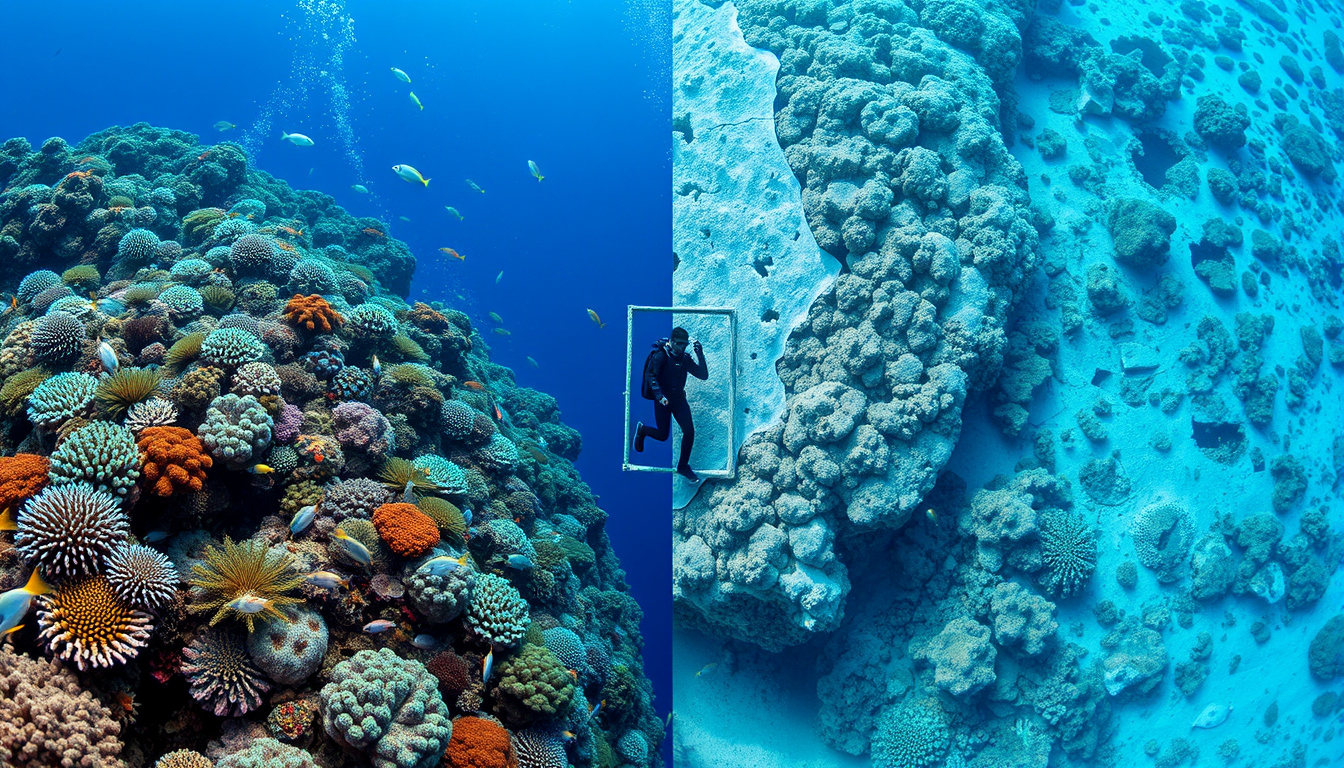
Few underwater ecosystems capture the imagination quite like coral reefs, but beyond the vibrant tropical images lies a hidden world of cold-water corals thriving in deep, dark waters off Ireland’s coast. This guide explores what makes a coral reef, why it matters, and how we can protect these fragile habitats—including the remarkable Lophelia pertusa reefs that host some of the deepest biodiversity hotspots on the planet.
Ocean floor coverage: less than 1% ·
Marine species supported: approximately 25% ·
Largest coral reef system: Great Barrier Reef (2,300 km) ·
Reef-building coral species: about 800 ·
Oldest known reef structures: over 500 million years
Quick snapshot
- Corals are animals, not plants (CORDAP global review)
- Cold-water coral reefs exist off Ireland and Scotland (Ulster Wildlife)
- Reefs support about 25% of marine life despite covering less than 1% of the ocean floor (OSPAR background document)
- Exact number of coral species still undiscovered in deep-water reefs (CORDAP review)
- Long-term success of current restoration methods for cold-water corals (University of Galway research)
- Whether some Lophelia reefs grew in iceberg plough marks from the last ice age (Ulster Wildlife)
- First known coral reefs appear over 500 million years ago (OSPAR)
- Cold-water reefs off Ireland first discovered in the 1970s (NPWS report)
- Widespread bleaching events recorded from 2015 to 2025 (Ulster Wildlife)
- Expansion of marine protected areas to safeguard deep-water reefs (UK Biodiversity Framework)
- Increased monitoring of Lophelia pertusa reefs under OSPAR (OSPAR)
Five key facts, one pattern: coral reefs punch far above their size in ecological and economic value, yet remain among the least understood ecosystems on Earth.
| Fact | Value |
|---|---|
| Largest coral reef | Great Barrier Reef (2,300 km) |
| Oldest known coral reef | Over 500 million years |
| Number of fish species supported | Approximately 4,000 |
| Global economic value | Estimated $375 billion per year |
| Percentage of ocean area | Less than 0.1% |
What exactly is a coral reef?
A coral reef is an underwater ecosystem built by colonies of tiny animals called coral polyps, held together by calcium carbonate skeletons. According to CORDAP, a global conservation initiative, cold-water corals include multiple taxa beyond the familiar tropical varieties—Octocorallia, some Hexacorallia, and even hydrozoans like Stylasteridae.
What is another name for a coral reef?
- Commonly called the “rainforests of the sea” for their biodiversity.
- No single alternative name exists; terms like “coral garden” or “reef ecosystem” are used contextually.
Are coral reefs animals or plants?
- Corals are animals—specifically, cnidarians related to jellyfish and sea anemones (OSPAR scientific background).
- Reef-building corals host symbiotic algae (zooxanthellae) that provide most of their energy through photosynthesis.
What are the main components of a coral reef?
- Calcium carbonate skeleton secreted by polyps.
- Living polyp tissue and the algal symbionts inside them.
- The reef framework—a complex three-dimensional structure that provides habitat.
The implication: understanding this animal origin is key to grasping why reefs are so fragile.
Why are coral reefs important?
Coral reefs protect coastlines from storms and erosion, support an estimated 25% of all marine species, and provide jobs, tourism, and fisheries worth billions. The OSPAR Commission notes that even cold-water Lophelia pertusa reefs serve as nursery grounds for deep-water fish.
For coastal communities in Ireland and Scotland, the economic value of cold-water reefs is not abstract—they sustain commercial fisheries worth tens of millions annually.
How do coral reefs protect coastlines?
- Reef barriers absorb wave energy, reducing erosion and storm surge impact (Ulster Wildlife).
- Healthy reefs can reduce wave height by up to 97%.
What economic value do coral reefs provide?
- Global fisheries, tourism, and coastal protection valued at $375 billion per year.
- In Ireland, the cold-water reefs of the Belgica Mound Province support deep-sea fishing and research tourism.
Why are coral reefs called the rainforests of the sea?
- Because, like rainforests, they host disproportionately high biodiversity in a small area—25% of marine species on less than 1% of the ocean floor (University of Galway marine ecology group).
The pattern: protecting these nurseries directly supports global food security.
How do coral reefs form?
Reefs form when coral polyps secrete calcium carbonate skeletons that accumulate over thousands of years. Growth rates vary from 1 to 15 mm per year for warm-water species; cold-water Lophelia pertusa grows even slower, at 4 to 25 mm per year (Ulster Wildlife).
What is the role of coral polyps in reef formation?
- Each polyp extracts calcium ions from seawater and combines them with carbonate to build its skeleton.
- Colonies of genetically identical polyps create massive frameworks over centuries.
How long does it take for a coral reef to grow?
- Warm-water reefs grow 1–15 mm per year; a mature fringing reef may take 10,000 years.
- Cold-water reefs at the Mingulay Complex are thought to be thousands of years old (Ulster Wildlife).
What are the different types of coral reefs (fringing, barrier, atoll)?
- Fringing reefs grow directly from shore.
- Barrier reefs are separated from land by a lagoon; the Great Barrier Reef is the largest example.
- Atolls are ring-shaped reefs that encircle a lagoon, usually atop submerged volcanic islands.
The catch: any interruption to this slow growth means centuries of lost accumulation.
Where are coral reefs found?
Warm-water reefs thrive in shallow tropical waters between 30°N and 30°S. But cold-water reefs exist in deep, dark waters worldwide, including a remarkable province off Ireland’s west coast. Ireland’s National Parks and Wildlife Service (NPWS) reports that Irish marine reef habitats extend from the intertidal zone to depths of 4,500 m, more than 400 km offshore.
Are there any coral reefs in Ireland?
- Yes. The Belgica Mound Province, a cold-water coral reef system, lies off the west coast of Ireland at depths of 500–1,200 m.
- Lophelia pertusa dominates and provides habitat for hundreds of deep-sea species (OSPAR).
What are cold-water coral reefs?
- Reefs built by corals that live in temperatures of 4–8°C, without sunlight, relying on filter-feeding or currents for food.
- They are listed as a Priority Habitat under the UK Post-2010 Biodiversity Framework (Ulster Wildlife).
What is the global distribution of warm-water coral reefs?
- Concentrated in the Indo-Pacific, Caribbean, and Red Sea.
- The Great Barrier Reef off Australia’s northeast coast is the largest, spanning 2,300 km.
Cold-water reefs are less visible than tropical ones, but their slow growth (4–25 mm/year) makes them even more vulnerable to damage from bottom trawling and ocean acidification.
What this means: the deep reefs off Ireland are irreplaceable carbon sinks and biodiversity reservoirs that need immediate protection.
Why shouldn’t you touch a coral reef?
Touching a coral can strip its protective mucus layer, introduce bacteria or pollutants, and cause stress that leads to bleaching or death. Some corals also have stinging cells that cause skin irritation (OSPAR).
How does touching harm corals?
- Physical contact destroys the delicate polyp tissue and can break the calcium carbonate skeleton.
- Sunscreen, oils, and bacteria from human skin can trigger infection.
What can happen to humans who touch corals?
- Stinging cells (nematocysts) can cause painful rashes or cuts that are slow to heal.
- In tropical waters, cuts may become infected with Vibrio bacteria.
What are the rules for interacting with reefs?
- Never touch, stand on, or collect coral.
- Use reef-safe sunscreen and maintain neutral buoyancy while diving.
- Respect marine protected area regulations.
The consequence: one careless touch can undo years of natural reef building.
What we know and what remains unclear
Confirmed facts
- Corals are animals, not plants (CORDAP)
- Cold-water reefs require specific temperatures (4–8°C) and currents (OSPAR)
- Touching corals damages them (Ulster Wildlife)
What’s unclear
- Exact number of undiscovered coral species in deep-water reefs (CORDAP)
- Long-term effectiveness of restoration methods for cold-water corals (University of Galway)
- Whether some Lophelia reefs grew in iceberg plough marks from the last ice age (Ulster Wildlife)
Perspectives on coral reefs
“Coral reefs provide significant coastal protection, sustain fisheries, and generate billions of dollars in tourism and recreation each year.”
NOAA Education (via OSPAR Commission)
“The Belgica Mound Province is one of Europe’s most important cold-water coral sites, supporting a rich biodiversity that includes deep-sea fish, sponges, and coral species found nowhere else.”
“Cold-water coral reefs are among the most biodiverse ecosystems in the deep sea, providing refuge, nursery, and shelter for many species.”
University of Galway marine ecology group
Coral reefs—both tropical and cold-water—are irreplaceable pillars of marine life. Their slow growth and sensitivity to warming, acidification, and physical damage mean every year of delayed action locks in centuries of loss. For Ireland, the choice is clear: protect the Belgica Mound Province through robust marine protected areas and sustainable fishing, or watch one of Europe’s last deep-water wonders vanish.
pmc.ncbi.nlm.nih.gov, researchrepository.universityofgalway.ie, sciencedirect.com
One of the most famous examples of these ecosystems is the Great Barrier Reef, which stretches over 2,300 kilometers along Australia’s coast.
Frequently asked questions
What animals live in coral reefs?
Thousands of species, including fish, molluscs, crustaceans, sea turtles, and sponges. Cold-water reefs host deep-water fish, corals, and unique invertebrates like the Lophelia pertusa reef community.
What is the difference between warm-water and cold-water reefs?
Warm-water reefs rely on sunlight and symbiotic algae; cold-water reefs thrive in dark, deep waters (4–8°C) without algae, feeding on plankton and organic particles.
Are coral reefs dying?
Yes — widespread bleaching events from 2015 to 2025 have killed large portions of tropical reefs. Cold-water reefs face threats from bottom trawling, ocean acidification, and warming deep waters.
How can I help protect coral reefs?
Use reef-safe sunscreen, avoid touching corals, support marine protected areas, reduce carbon footprint, and choose sustainable seafood.
Can coral reefs recover from damage?
Yes, but recovery is extremely slow (decades to centuries) and requires stable conditions. Restoration projects are underway but face uncertainty in warming oceans.
What is the role of algae in coral reefs?
Symbiotic zooxanthellae provide up to 90% of the energy for warm-water corals through photosynthesis. Cold-water corals lack algae and rely on filter-feeding.
Related reading
- Sea Life Sunshine Coast Tickets — Explore marine life exhibits including coral reef displays.
- Sydney to Cairns Travel Guide — Great Barrier Reef destinations and travel tips.

Jack Hayes is Senior Reporter at Australia Data, covering breaking stories and explainers.