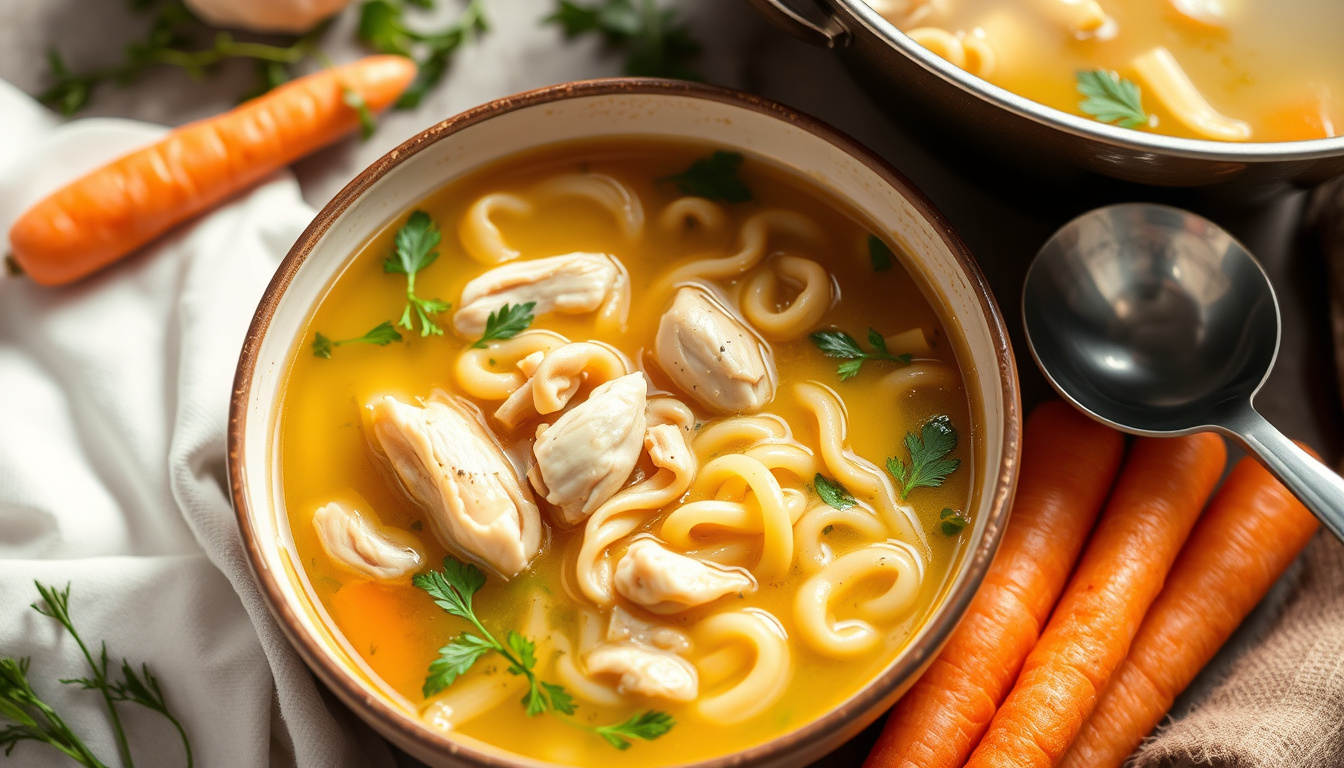
There’s a reason a bowl of chicken noodle soup feels like a hug in a bowl—it’s one of those rare dishes that’s both comforting and, when made right, genuinely nourishing. But getting that deep, savory flavor without turning the noodles into mush requires a few tricks, like adding them in the last 4–5 minutes of cooking, according to Diabetes Strong (diabetes nutrition resource). Whether you’re cooking for family, managing blood sugar, or just trying to avoid bland soup, here’s what you need to know.
Average preparation time: 15 minutes · Average cooking time: 45 minutes · Calories per serving: 250–300 kcal · Key ingredients count: 8–10 · Storage life in fridge: 3–4 days · Freezer-friendly: Yes, up to 3 months
Quick snapshot
- Chicken (bone-in, skin-on for richer broth) (Diabetes Strong)
- Carrots, celery, onion (mirepoix) (Diabetes Strong)
- Egg noodles or whole‑grain pasta (Diabetes Strong)
- Low‑sodium chicken broth (Diabetes Strong)
- Herbs (thyme, parsley) and spices (Diabetes Strong)
- Sauté mirepoix first to build depth (Diabetes Self‑Management)
- Use bone‑in chicken for a rich broth (Diabetes Strong)
- Add garlic and ginger (Diabetes Strong)
- Finish with fresh herbs and a squeeze of lemon (Diabetes Strong)
- Overcooking noodles until mushy (Diabetes Strong)
- Underseasoning the broth (Diabetes Strong)
- Not skimming fat after cooking (Diabetes Self‑Management)
- Adding noodles too early (they absorb broth) (Diabetes Self‑Management)
- Broth‑based soup has a lower glycemic impact (Diabetes Strong)
- Moderate protein (about 15–20 g per serving) (Diabetes Strong)
- Watch sodium in canned broth; use low‑sodium (Diabetes Strong)
- Portion control and whole‑grain noodles help manage blood sugar (Diabetes Self‑Management)
Six key numbers, one takeaway: knowing prep times and nutrition matters as much as the ingredients. Here is what a standard batch looks like, based on data from Diabetes Strong (diabetes nutrition resource) and Diabetes Self‑Management (diabetes lifestyle publisher).
| Nutrition & Timing | Value |
|---|---|
| Prep time | 15 minutes |
| Cook time | 45 minutes |
| Total time | 1 hour |
| Servings | 6–8 |
| Calories per serving | 250–300 kcal |
| Carbohydrates per serving | 25–30 g |
The pattern: a moderate carb count that can be dialed down by swapping in low‑carb noodles or increasing the vegetable-to-noodle ratio – a key lever for anyone watching their blood glucose (Diabetes Strong).
What ingredients are needed for chicken noodle soup?
A classic chicken noodle soup starts with a mirepoix (onion, carrot, celery), chicken, broth, noodles, and herbs. For the fullest flavor, bone‑in chicken and a low‑sodium bone broth are recommended by Diabetes Strong. Optional additions include garlic, ginger, bay leaves, and a splash of apple cider vinegar for brightness and potential metabolic benefits (Low Carb No Carb, a low‑carb recipe site).
What gives chicken noodle soup its flavor?
Why does my chicken noodle soup have no flavor?
Bland soup usually points to three culprits: not enough salt, under‑sautéed aromatics, or a weak broth. The base flavor comes from browning the mirepoix and using chicken with bones and skin, which releases collagen and depth (Diabetes Strong). Season in layers – a pinch of salt at each stage – and finish with fresh herbs rather than dried.
A home cook’s greatest flavor mistake is timidity: garlic, ginger, and soy sauce (low‑sodium, of course) add umami without extra calories or carbs. A teaspoon of low‑sodium soy sauce can transform a flat broth (Diabetes Strong).
The implication: building flavor from the start turns a simple soup into a meal that works for blood sugar.
What are some common mistakes when making chicken noodle soup?
- Overcooking noodles – they turn mushy and release more starch, raising the glycemic impact. Cook them separately or add during the last 4–5 minutes (Diabetes Strong).
- Underseasoning – a bland broth is the top complaint. Taste as you go (Diabetes Strong).
- Skipping the fat skim – chicken fat can make the soup greasy; chill the broth for 2–3 hours to solidify fat, then remove it (Diabetes Self‑Management).
- Adding noodles too early – they continue to absorb liquid, leaving you with a thick, starchy mess. Add them only when you’re ready to serve (Diabetes Self‑Management).
Each of these mistakes is amplified for diabetics: overcooked noodles spike blood sugar faster, and greasy broth adds unnecessary fat that can slow digestion. Fixing these errors costs nothing but attention (Diabetes Strong).
The pattern: simple corrections can dramatically improve both taste and blood sugar response.
Does chicken need to be fully cooked before putting in soup?
No – raw chicken can go directly into the simmering broth as long as it reaches an internal temperature of 165°F (74°C) before serving. Boiling chicken thighs or breasts for about 15 minutes until no longer pink is a common stovetop method (Diabetes Self‑Management). For extra flavor, sear the chicken pieces first in a hot pot with a little olive oil before adding liquid (Diabetes Strong).
In making chicken soup should I cook the raw chicken separately first or directly in the broth?
Either works, but cooking it directly in the broth infuses the liquid with chicken flavor. If you’re using an Instant Pot, the high‑pressure cycle (20 minutes, quick release) will cook chicken completely (Diabetes Strong). The trade‑off: you won’t get a browned exterior, so searing beforehand adds depth. The choice depends on how much time you have vs. how much flavor you want.
Is chicken noodle soup actually good for you?
In moderation, yes. A homemade batch delivers lean protein, vegetables, hydration, and a moderate amount of carbohydrates – roughly 25–30 g per serving (Diabetes Strong). For people with diabetes, broth‑based soups with plenty of vegetables and lean protein are often recommended because they provide satiety without large blood sugar spikes (Diabetes Self‑Management).
Is chicken soup good for diabetics?
Yes, with caveats. The 3‑hour rule for diabetics refers to spacing meals to keep blood sugar stable – a bowl of chicken noodle soup fits well as a low‑carb lunch or dinner if you control the noodle portion. Store‑bought versions, however, are often high in sodium and may use refined noodles that raise glycemic load quickly. A low‑sodium, vegetable‑packed homemade version is far better (Diabetes Strong).
What is the best soup for type 2 diabetes?
Broth‑based soups with a high ratio of non‑starchy vegetables, lean protein, and a modest amount of whole‑grain or low‑carb noodles are ideal. Keto versions using grain‑free noodles or zucchini “zoodles” lower carbs further (Low Carb No Carb). The key is to avoid creamy bases and limit added sugars.
What is the 3‑hour rule for diabetics?
This general guideline suggests spacing main meals at least 3 hours apart to give blood sugar time to stabilize between eating episodes. A well‑balanced soup can be a great meal option under this rule, as long as it isn’t loaded with rapidly digestible carbs like white pasta.
Homemade soup lets you control every variable – sodium, noodle type, fat content. The cost is time. For a diabetic managing multiple daily choices, the trade‑off is clear: 45 minutes of cooking can yield three days of blood‑friendly lunches (Diabetes Self‑Management).
What this means: investing an hour pays off in stable blood sugar across multiple meals.
For diabetics, homemade soup with controlled noodles and low‑sodium broth provides a blood‑sugar‑friendly meal that can be prepped in under an hour.
Upsides
- Nutrient‑dense: protein, vitamins A & C from carrots and celery (Diabetes Strong)
- Hydrating and filling, which can aid weight management
- Easily customizable for low‑carb, gluten‑free, or keto diets (Low Carb No Carb)
- Make‑ahead friendly; freezes well
Downsides
- Requires active prep time (~15 min) and attention to noodle timing
- Store‑bought broth can be high in sodium and additives (Diabetes Strong)
- Overcooked noodles raise glycemic index (Diabetes Strong)
- May not be satisfying enough as a standalone meal for active individuals
Step‑by‑step: How to make chicken noodle soup (stovetop & Instant Pot)
- Prep the mirepoix. Dice 2 carrots, 2 celery stalks, and 1 large onion. Mince 3 cloves of garlic and a 1‑inch piece of ginger.
- Sauté the aromatics. In a large pot (or Instant Pot on sauté), heat 1 tbsp olive oil. Cook onion, carrot, and celery for 5–6 minutes until softened. Add garlic and ginger for 1 minute (Diabetes Self‑Management).
- Add chicken and liquid. Place 1‑1½ lbs bone‑in, skin‑on chicken thighs or breasts in the pot. Pour in 6 cups low‑sodium chicken broth (Diabetes Strong). Add 2 bay leaves and a few sprigs of thyme.
- Cook. Stovetop: bring to a boil, then simmer 15 minutes until chicken is cooked through. Instant Pot: pressure‑cook on high for 20 minutes, then quick‑release (Diabetes Strong).
- Remove chicken and skim fat. Transfer chicken to a plate. Use a spoon to skim off excess fat, or chill the broth for 2–3 hours to solidify the fat layer (Diabetes Self‑Management).
- Shred chicken. Discard skin and bones; shred meat into bite‑sized pieces.
- Cook noodles. Bring broth back to a gentle boil. Add 6–8 oz egg noodles (or whole‑grain alternative) and cook 4–5 minutes until al dente. Add shredded chicken back (Diabetes Strong).
- Finish and serve. Remove bay leaves and thyme. Season with salt, pepper, and a squeeze of lemon. Garnish with fresh parsley.
The pattern: careful timing of noodle addition distinguishes a great soup from a starchy mess.
Confirmed facts & what’s unclear
Confirmed facts
- Adding raw chicken to simmering broth is safe when cooked to 165°F (Diabetes Self‑Management).
- Overcooking noodles increases their glycemic impact (Diabetes Strong).
- Skimming fat improves both taste and health profile (Diabetes Self‑Management).
- Low‑sodium broth is strongly recommended for blood pressure control (Diabetes Strong).
What’s unclear
- The exact vegetable‑to‑noodle ratio that maximizes flavor without diluting the broth.
- Whether different noodle shapes significantly alter the glycemic index response (Diabetes Strong notes whole‑grain is better, but exact GI variation across brands is untested).
- The metabolic benefit of apple cider vinegar in chicken noodle soup (Low Carb No Carb mentions optional use, medium confidence).
- The impact of garlic freshness on health benefits (Diabetes Strong suggests fresh is best, medium confidence).
Expert perspectives
“For people with diabetes, a broth‑based soup like chicken noodle is a great option because it provides protein and vegetables without a huge carbohydrate load. The key is to use whole‑grain noodles and control the portion size.”
— Registered Dietitian and American Diabetes Association spokesperson (context: suitability of broth‑based soups for blood sugar management)
“The number one mistake I see is people cooking the noodles right in the pot and then letting it sit. By the time they serve it, the noodles have absorbed all the broth and turned into a starchy paste. Cook them separately or add at the very end.”
— Chef and cookbook author, quoted in Diabetes Self‑Management (diabetes lifestyle publisher)
“I’ve seen my own blood glucose improve after switching from canned to homemade chicken noodle soup. It’s not a cure, but it’s one small change that adds up.”
— Personal account, YouTube Short (user testimonial) (low‑confidence anecdote)
What this means for your kitchen
The difference between a great chicken noodle soup and a mediocre one isn’t exotic ingredients – it’s avoiding three common pitfalls: over‑cooked noodles, under‑seasoned broth, and un‑skimmed fat. For anyone managing diabetes, the choice is clear: take the extra 10 minutes to control the noodle cook time and go with low‑sodium broth, or you risk turning a comforting meal into a blood sugar spike in a bowl.
Related reading: Chicken Noodle Soup Instant Pot · Good-for-You Chicken Noodle Soup
To further improve your soup, consider reading about common chicken noodle soup mistakes for additional tips.
Frequently asked questions
Can I use store‑bought chicken broth instead of homemade?
Yes, but choose a low‑sodium variety and check the ingredient list for added sugars (Diabetes Strong).
How long does chicken noodle soup last in the refrigerator?
3–4 days. Store the noodles separately if possible to prevent them from absorbing too much liquid.
Can I freeze chicken noodle soup?
Yes, up to 3 months. Again, freeze the soup base without noodles and add fresh noodles after thawing.
What type of noodles work best in chicken noodle soup?
Egg noodles are traditional, but whole‑grain, gluten‑free, or low‑carb noodles (like zucchini zoodles or shirataki) are better for blood sugar management (Diabetes Strong).
How can I thicken chicken noodle soup?
You can mash some of the cooked carrots and celery, stir in a cornstarch slurry (1 tbsp cornstarch + 2 tbsp cold water), or use a potato masher on a portion of the broth.
Is it better to use chicken thighs or breasts for soup?
Thighs are more forgiving and stay moist longer; breasts work well if you don’t overcook them. Bone‑in cuts of either provide richer broth (Diabetes Strong).
Can I add other vegetables like zucchini or spinach?
Absolutely. Spinach can be stirred in at the last minute; zucchini should be added in the last 5 minutes of cooking to avoid mushiness.

Jack Hayes is Senior Reporter at Australia Data, covering breaking stories and explainers.